Table of Contents
Your rankings haven't moved. Your content is solid. Your site is technically clean.
But your traffic numbers keep cratering.
Welcome to 2026. Where doing everything right doesn't mean what it used to.
The Golden Age (And Why We Didn't Know It)
Let's rewind.
Five years ago, search was simple. Someone wanted to know about a kids gym franchise. They typed a relevant keyword or synonym into Google. The search engine served up a list of blue links. And if you were good at SEO and you'd done the work, built the content, and earned the authority, then your website was right there at the top. So top franchises like We Rock the Spectrum would show up in poll position.
Prospects clicked. They landed on their site. They read the content, saw the photos, absorbed their value proposition, maybe filled out a form or scheduled a meeting.
That's how it worked. Someone was interested in owning a kids gym franchise, Google pointed them out, and they had your shot to make an impression and convert the prospect.
We all built our businesses on that model. Marketing teams optimized for it. Agencies (including us) refined it, specifically for WRTS. And it worked!
Unfortunately, that model is fundamentally broken now. Not dead, but broken. And there's a massive difference…
What Changed (And Why You Didn't See It Coming)
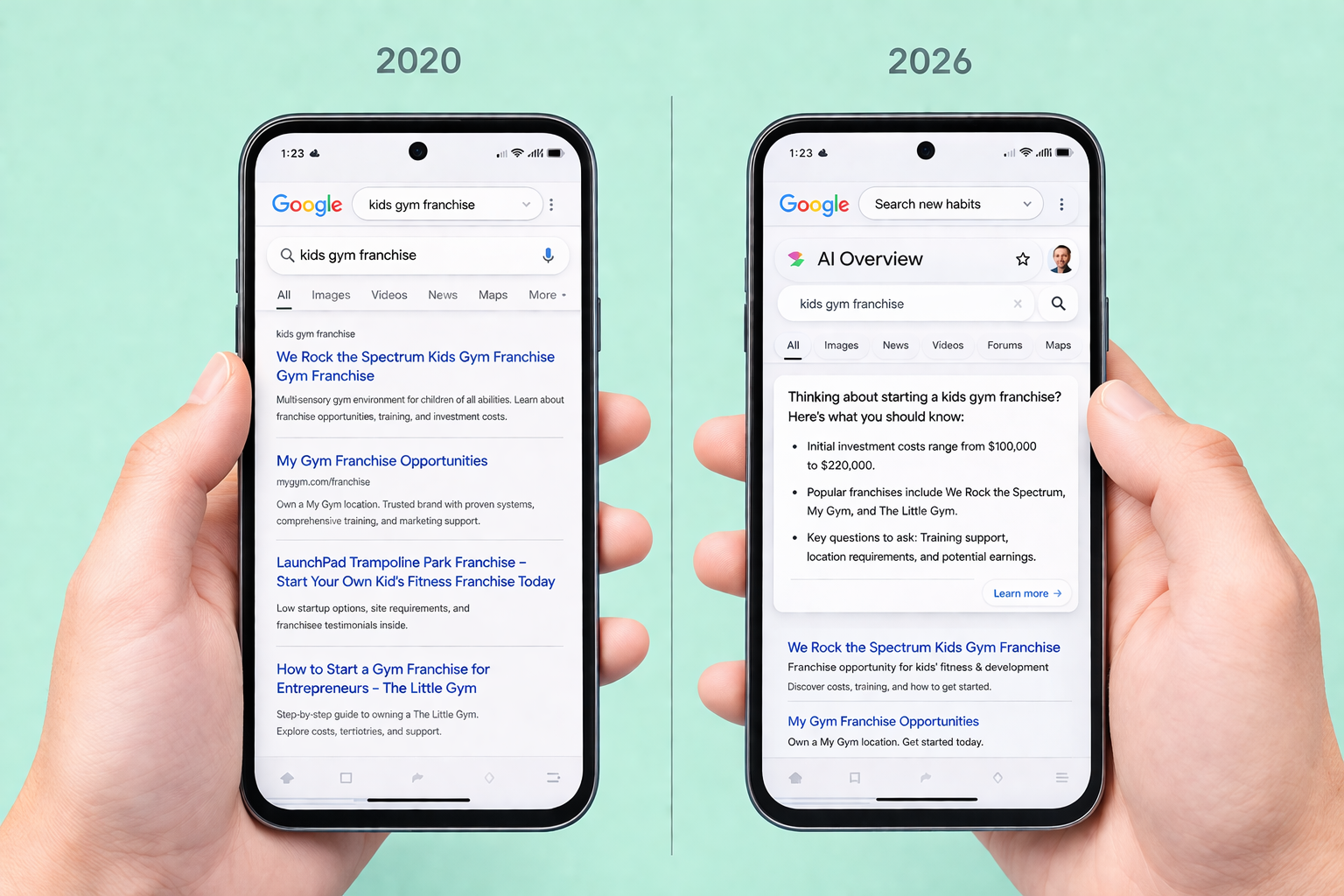
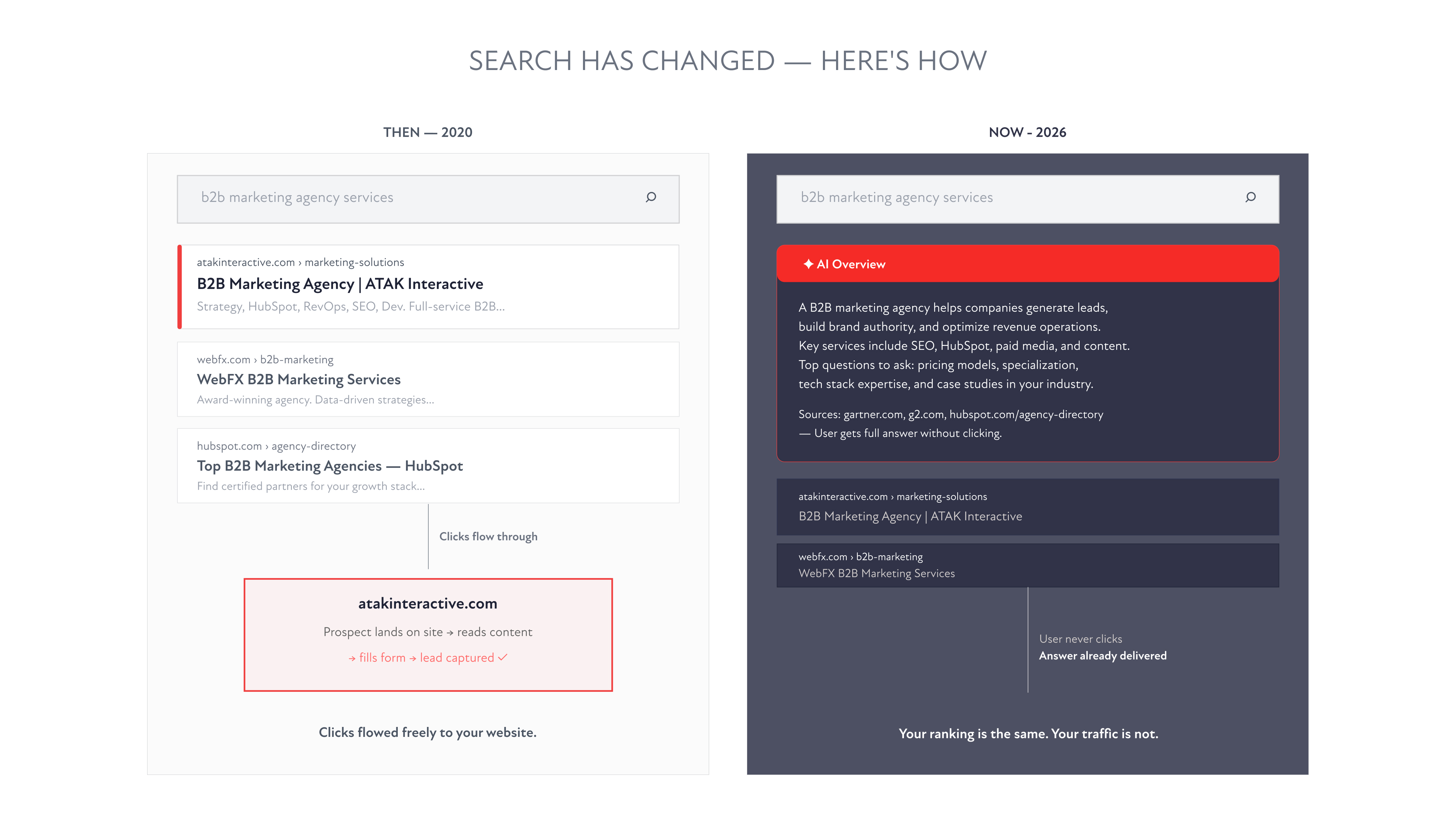
Here's what happens when someone searches "kids gym franchise" today.
They type it in. Google serves up an AI-generated Overview right at the top of the page — a synthesized summary of what a kids gym franchise is, what it costs, what questions to ask, and maybe even a few brand names that come up frequently in trusted sources. All the information a curious user needs to get oriented.
We Rock the Spectrum Kids Gym still owns that search, but it used to be different. Top result. Clicks rolling in to their website. The user enters a beautifully organized franchise site, full of curated information, compelling photos, and conversion-optimized pages, doing exactly what it was built to do.
Now? A user can learn what We Rock the Spectrum is, what kind of franchise opportunity it represents, and how it compares to alternatives without ever setting foot on their website simply through the Gemini Overview.
The information is still out there. But the website is no longer the front door.
That's the shift. And it's not a bug in the system. It's the system working exactly as Google designed it.
The Numbers Are Not Your Friend (Yet)
Let's talk data, because the scale of this is staggering.
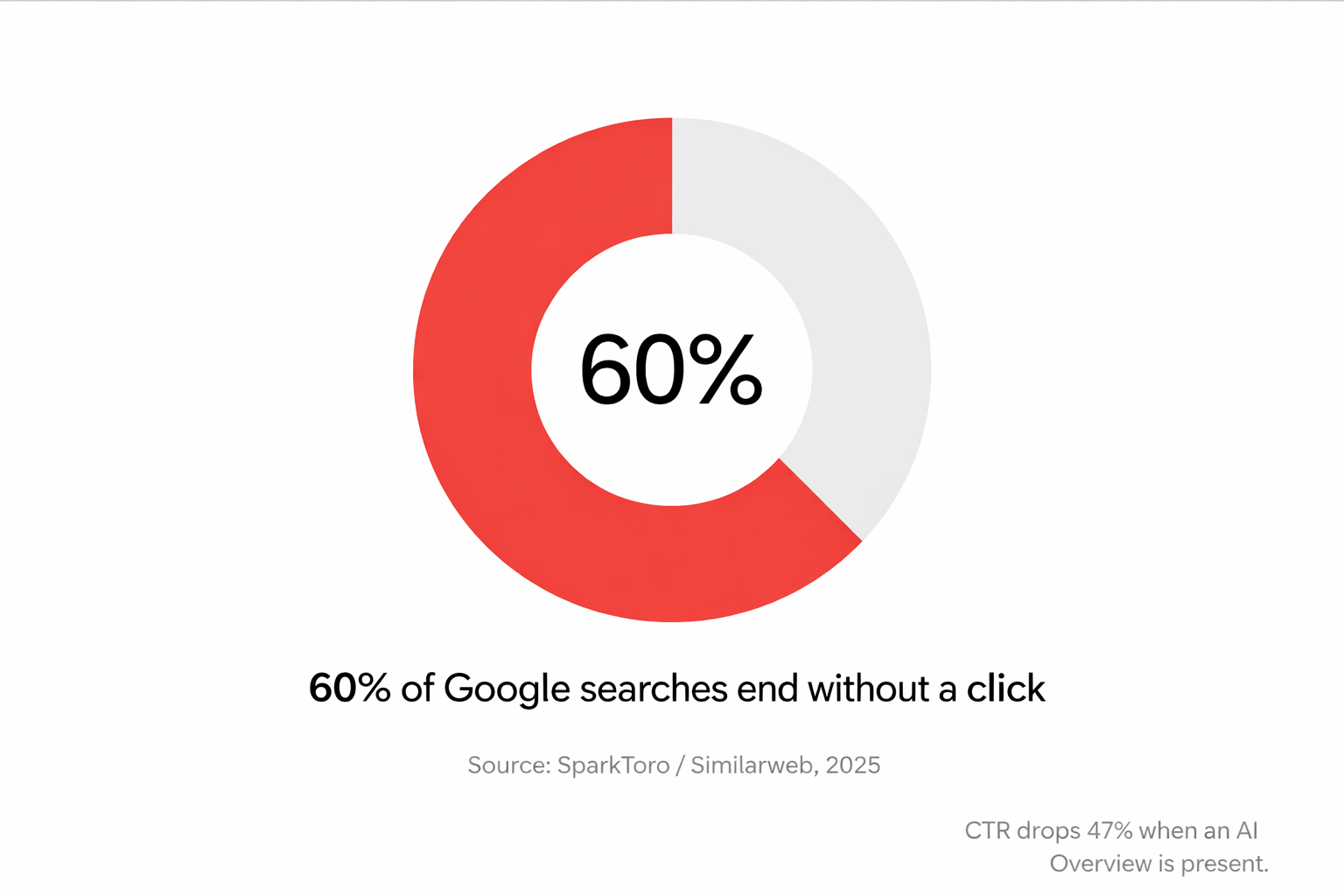
60% of Google searches now end without a single click. Not just a majority, but three out of five searches result in zero website visits. Users get what they need from the results page itself and move on.
When a Google AI Overview is present on a results page, click-through rates drop to just 8% — compared to 15% when traditional results appear without an overview. That's nearly a 47% relative reduction, per Pew Research's study of 68,000 real search queries.
Seer Interactive's September 2025 analysis of 25 million organic impressions found organic click-through rates plummeted 61% — from 1.76% to 0.61% — for queries that triggered AI Overviews.
The collateral damage is real. Non-news brands saw 14% year-over-year declines in referred traffic from Google Search in the first half of 2025. HubSpot, one of the best SEO operations in the world, lost nearly half its organic traffic in a matter of months. Their own CEO acknowledged it on an earnings call: "AI Overviews are giving answers, and fewer people are clicking through to websites."
And AI Overviews aren't niche anymore. They now appear in 50% - 60% of all queries, more than double where they were at the start of 2025. Expansion is accelerating and not looking back.
If HubSpot isn't safe, nobody is.
There's Something Bigger Going On
Here's what most people miss when they look at this data.
The traffic drop is real. But the drop alone isn't the whole story.
Your actual potential customers never wanted to hand over their information before they were ready. They never loved filling out forms on the first visit. They never enjoyed being retargeted before they knew who you were. They put up with it because that's what browsing the web required.
Now they don't have to.
Gartner found that 80% of the B2B buying journey happens without any direct vendor contact. According to 6sense's 2025 Buyer Experience Report, buyers are 61% of the way through their decision-making process before they ever reach out to a sales team. And 81% of the time, they already have a preferred vendor in mind when they do.
Think about that for a second. Your buyers are researching you, evaluating you, and shortlisting you or eliminating you entirely without you knowing. The first time they call, they've basically already decided if you’re on the short list or not.
This isn't a new behavior that AI created. AI just accelerated and normalized it.
The modern buyer doesn't want to give you their email address until they trust you. They don't want to book a demo until they're ready. They don't want to see a sales pitch at the moment they're still figuring out what they need.
Google's AI Overviews didn't create that preference. They just gave buyers a new, frictionless way to satisfy it.
The Uncomfortable Reframe
So let's be direct about what this means.
You can rank #1 and still be invisible to buyers who got what they needed from the Overview.
You can have a gorgeous, information-rich website that never gets visited by the people most likely to convert.
You can be doing everything right by 2020 standards and watching your pipeline slow down.
The instinct is to panic. To declare SEO dead, to pivot everything, to chase the next tactic.
Don't.
The instinct should be to understand what's actually happening and use it to your advantage.
The Opportunity Hidden
Here's the part most marketing teams haven't thought through yet.
Being cited in an AI Overview is not a consolation prize. It's the new version of ranking #1.
Seer Interactive's data found that brands cited in AI Overviews earned 35% more organic clicks and 91% more paid clicks than those not cited on the same queries. One AI citation can generate more qualified traffic than ranking #3 for the same query in traditional results.
And here's the behavior pattern that makes this interesting: 72% of buyers encountered Google's AI Overviews during their research, and 90% clicked through to at least one cited source. These aren't passive readers. They're buyers who used the Overview to get oriented, then clicked deeper on the sources they found credible.
The Overview isn't replacing your website. It's becoming the filter between searchers and your website. The brands that get cited are the ones that built enough authority, structure, and depth to earn the reference.
This is actually a higher bar than traditional SEO which is exactly why it's an opportunity. Most of your competitors won't figure this out in time.
What Winning Looks Like in 2026
The goal has shifted. Traffic is a lagging indicator. Visibility is the new leading one.
Here's what that means practically:
Stop measuring success by clicks alone. Are you showing up in AI Overviews for your core queries? Are you being cited by Perplexity when someone researches your category? Does Google's AI synthesize your content as part of its answer? These are the new KPIs that predict future pipeline.
Build content that earns citation, not just clicks. AI systems favor depth, authority, and structure. That means comprehensive topic coverage — not a blog post for every keyword, but a genuine body of expertise that AI tools recognize as the definitive source on your subject. Thin content doesn't get cited. Expert content does.
Structure everything for extraction. Clear headers. Direct answers in the first 40-60 words of each section. FAQ formatting. Schema markup. Tables. These signals tell AI systems: this content is organized, reliable, and easy to synthesize. Make it easy for them to love you.
Think about the second click. The buyer who reads an AI Overview about your category isn't lost - they're warmed up. If your name appeared in that Overview, their next move is often a branded search or a direct visit. That's where your website still matters enormously. Build for the buyer who arrives already knowing who you are. Lead with trust, not with forms.
Earn citations from credible sources. AI systems weigh authority heavily. The publications, directories, and industry sites that reference you become pathways for AI tools to discover and cite your content. This is link-building with a new purpose — citation worthiness. It’s the way modern PR should operate.
How ATAKSearch Approaches This
At ATAK, ATAKSearch was built for exactly this environment.
The old model of search marketing — target a keyword, rank a page, count the clicks — is one slice of a much bigger picture. ATAKSearch is about total search visibility: traditional rankings, AI citation strategy, content architecture that earns references, and measurement frameworks that capture influence beyond the click.
We don't just want you ranking. We want you cited. We want your name appearing in the AI Overviews that your buyers are reading before they ever decide to reach out. We want your website to convert the visitors who arrive already convinced. They encountered your brand in the research phase and then they started showing up with authority.
The Bottom Line
Your traffic drop isn't a mystery. It's a symptom of a system that's working exactly as designed for customers.
The buyers are still out there. They're still searching, still researching, still building shortlists. They're just doing it in a new environment that lets them get much further without raising their hand.
That's not a reason to pull back. It's a reason to show up more deliberately, in more places, with more authority.
The brands that figure this out that get cited in AI Overviews, that build content worth referencing, that create websites worth visiting for buyers who already trust them, are the ones who will lead in this latest era of search.
The ones who keep looking at the wrong scoreboard will keep wondering why their traffic is dropping.
Want to learn more about ATAKSearch? Request a Free Consultation
FAQs