Table of Contents
A few weeks ago, I was poking around in RB2B and noticed something I wasn't expecting: a steady trickle of new visitors were landing on some of our older SEO blog posts - posts we'd written years ago and hadn't touched since.
At first, it was a small dopamine hit. Hey, that old blog still works. But then I actually read the posts and realized they were referencing tactics, tools, and timeframes that were genuinely out of date. People with real buying intent were finding ATAK through content that didn't reflect what we actually believe about SEO in 2026.
That's when it clicked. We’re not alone. Most B2B companies are sitting on a goldmine of old content that's still pulling traffic, but isn't built for how people or AI engines actually search today.
I asked our team about it and of course, they had been prioritizing this for clients for months and already seeing better conversions as a result. Which makes sense. We click on things all the time and quickly realize it’s not what we’re looking for. Except if you’re not careful, your ICP will say that about your content, and the opportunity to turn a browser into a buyer will have vanished.
Why Updating Beats Starting From Scratch (Almost Every Time)
Here's the math that should keep you up at night. HubSpot famously ran a "historical optimization" experiment where they systematically updated older blog posts. The result was a 106% increase in organic search views for the updated posts without writing a single new article.
That tracks with what every SEO practitioner already knows: it is dramatically easier to push an existing, indexed, link-earning page from position 14 to position 4 than it is to get a brand-new page noticed at all. Google's already crawled it. It already has internal links pointing at it. It already has some intent signal attached to it.
And now, with AI engines like ChatGPT, Perplexity, Gemini, and Claude pulling from indexed content to generate answers, those same old pages are doing double duty. They're showing up in classic search and potentially getting cited inside AI-generated responses…but only if they're built right.
The opportunity cost of ignoring your existing content isn't just leaving traffic on the table. It's letting outdated information represent your brand in front of qualified buyers and missing out on AI visibility you could be earning with a few hours of focused work per post.
What “SEO + AEO + GEO Readiness” Actually Means
Quick refresher, because these acronyms blur together:
- SEO is the classic game, ranking in traditional search results.
- AEO is about being the source that gets surfaced when someone asks a question, and an answer engine (Google's AI Overviews, Bing Copilot) pulls a direct answer.
- GEO is about being cited and quoted inside generative AI responses - ChatGPT, Perplexity, Gemini, Claude.
The good news: a lot of what works for one works for all three. The bad news: most content written more than two years ago wasn't built with AEO or GEO in mind at all. No structured data, no clear question-and-answer formatting, no schema, no FAQ sections, no clean topical authority signals.
That's the gap you're auditing for.
A Simple Framework for the Audit
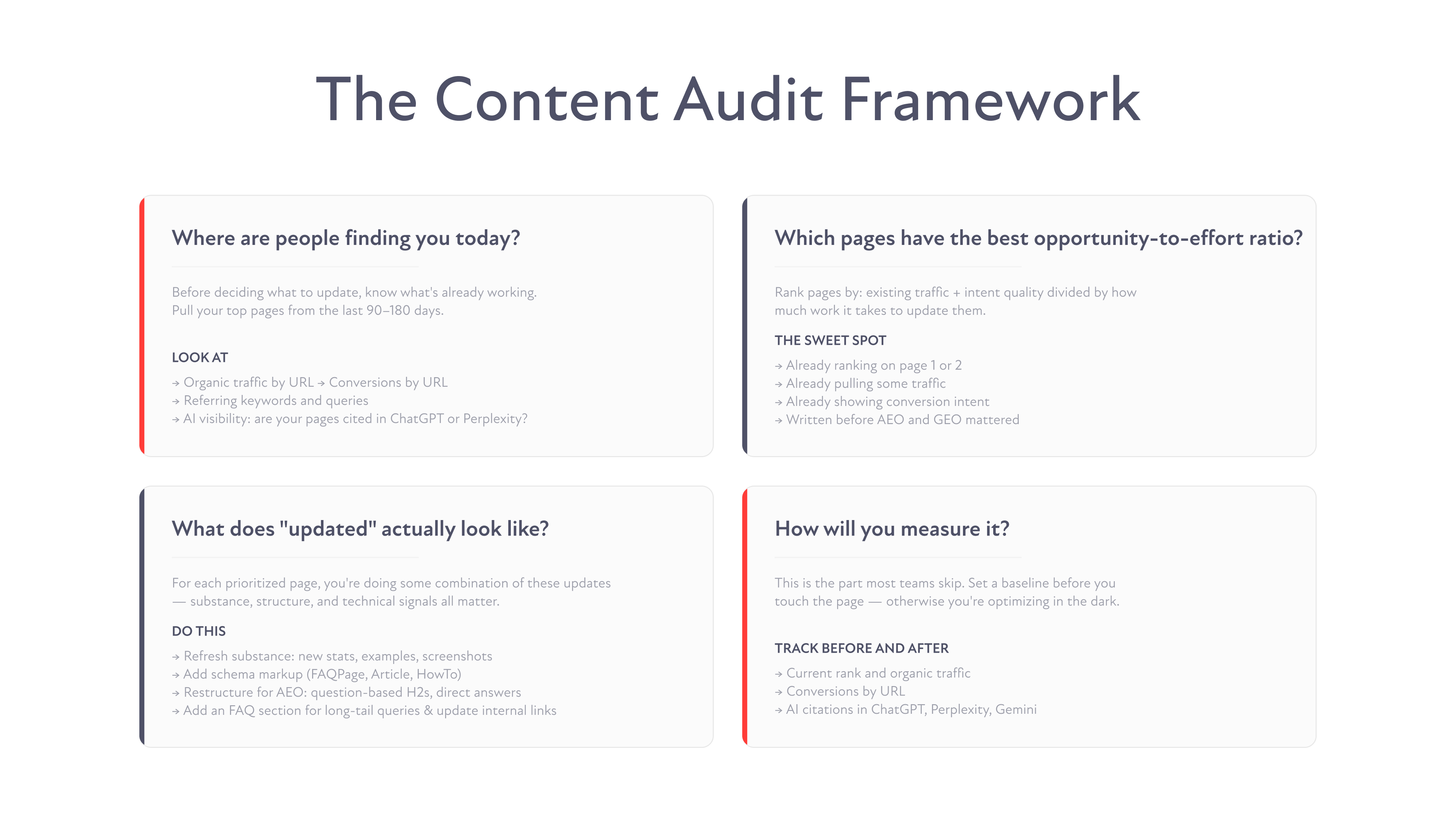
You don't need a 40-tab spreadsheet to do this well. You need to answer four questions in order.
1. Where are people actually finding you today?
Before you decide what to update, you need to know what's already working. Pull a list of your top-performing pages from the last 90–180 days and look at:
- Organic traffic by URL
- Conversions (form fills, demo requests, content downloads) by URL
- Referring keywords and queries
- AI visibility. Are any of your pages being cited in ChatGPT, Perplexity, or Google AI Overviews?
If you can't easily answer that last one, you're not alone. Most B2B teams don't have AI visibility tracking set up yet. (More on how we handle that in a minute.)
2. Which pages have the highest opportunity-to-effort ratio?
Rank your existing pages by a simple equation: existing traffic + intent quality (are they converting?) divided by how much work it would take to bring them up to today's standard.
The sweet spot: pages that are already ranking on page one or two, already pulling some traffic, already showing intent, but were written before AEO and GEO mattered. Those are your fastest wins.
3. What does "updated" actually look like?
For each prioritized page, you're doing some combination of:
- Refreshing the substance - new stats, new examples, new tactics, current screenshots
- Adding schema markup (FAQPage, Article, HowTo, Organization — whichever fits)
- Restructuring for AEO - clear question-based H2s, concise direct answers in the first paragraph under each, scannable formatting
- Adding an FAQ section to capture long-tail and conversational queries
- Updating internal links to point to your current best content
- Refreshing the publish date only if the substance has meaningfully changed (don't fake-freshen)
4. How will you measure it?
This is the part most teams skip. Set a baseline before you touch the page - current rank, traffic, conversions, AI citations - and check back at 30, 60, and 90 days. If you don't have this tracking, get it set up before you start updating anything. Otherwise, you're just hoping.
The Easiest Place to Start: Anything With a Year in the Title
If you want a five-minute exercise that will pay off this week, search your own site for blog posts with a year in the title or URL.
"Best Practices for 2022." "Top Tools for 2023." "What to Expect in 2024."
Every one of those is silently telling Google and every AI engine that crawls your site that your content is stale, even if the underlying advice is still sound. Update the year, refresh the stats and examples that have aged out, add a brief "what's changed since we first wrote this" note, layer in the right schema, and republish.
It's the lowest-effort, highest-confidence move in the entire audit. You don't have to start from scratch. You just have to bring it into the current era.
Where ATAK Can Help
The honest truth: most teams can't run a real SEO/AEO/GEO audit because they don't have visibility into where they're showing up in AI-generated answers. Traditional rank tracking tools weren't built for it.
Our ATAKSearch product is how we close that gap for our clients. It tells you:
- Which of your pages are being surfaced in answer engines and generative AI responses
- Where your competitors are getting cited that you aren't
- Which existing pages have the highest upside if you optimize them for AEO and GEO
- How your visibility shifts over time as you update content
From there, our team can either guide your in-house writers through the audit and updates, or we'll do the heavy lifting and rebuild the highest-opportunity pages with the right substance and the right technical foundation.
Either way, the first step is the same: figure out what you already have that's working, and stop letting it work at half-capacity.
If you're staring at a content library that hasn't been touched in two years and wondering where to start — start with the data. Find your goldmine. Then build the right plan to mine it.
Want help running the audit? That's what we do.
FAQs