Table of Contents
I was looking at our traffic reports a few weeks ago and saw firsthand the transformation.
Our organic Google traffic was down. Meanwhile, a line in our analytics that barely existed a year ago was climbing: referrals from ChatGPT, Perplexity, and Claude.
The channel had shifted. The reporting hadn't.
If you're still running your content program on rank tracking alone, you're measuring one-third of the picture. Maybe less.
As we enter this new era, the desire for metrics that matter is as important as ever. We just need to know what they are - and how to measure them.
The Old Funnel vs. The New Funnel
Let's start with the shift everyone is feeling but most aren't yet measuring.
|
The Old Funnel |
The New Funnel |
|
Google impression |
AI prompt (ChatGPT, Gemini, Perplexity, Google AI Mode) |
|
Click from SERP |
Brand mention inside the AI answer |
|
Landing page view |
Citation (your URL listed as a source) |
|
Form fill / calendar booking |
Branded search or direct visit later |
|
Page view (arriving pre-convinced) |
|
|
Form fill / calendar booking |
Two things jump out.
First, the new funnel has more steps. The buyer now researches privately — inside an AI chat — before they ever touch your site. By the time a conversion happens, the influence has already happened somewhere you can't see without the right tooling.
Second, the measurement layer has to move upstream. In the old world, a click was the first signal you existed. In the new world, a click might be the fourth or fifth signal and you'll never know the first three happened unless you're tracking them deliberately.
That's the gap. Now let’s talk about how we close it.
The New Metrics That Matter
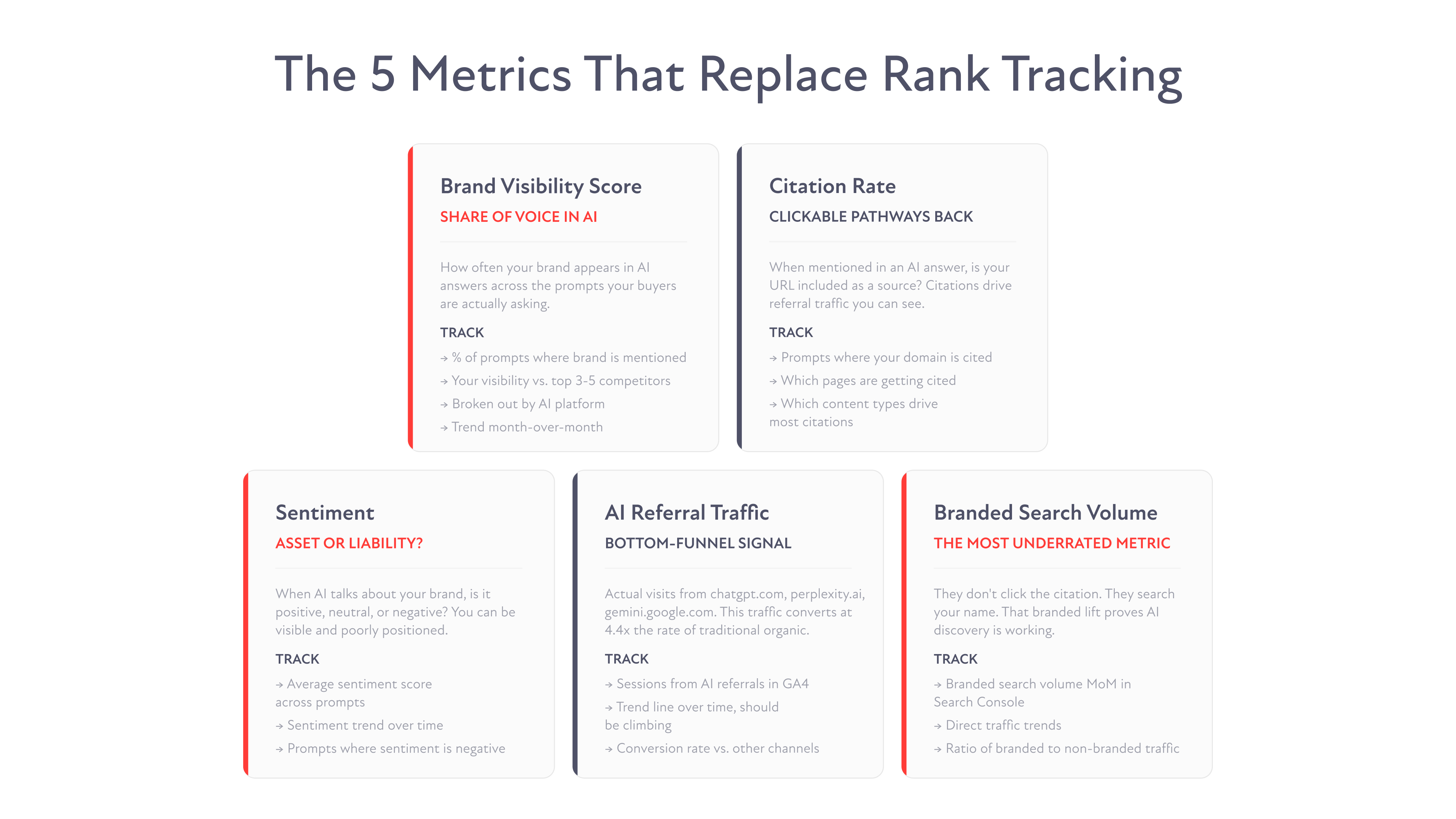
There are five metric categories worth building into your dashboard. I'll break each down — what it measures, why it matters, and what a healthy number looks like.
1. Brand Visibility Score (a.k.a. Share of Voice in AI)
What it measures: How often your brand appears in AI answers across a defined set of prompts your buyers are actually asking ChatGPT, Gemini, Perplexity, and Claude.
Why it matters: This is the new "keyword rank." If you don't show up in the answer, you don't exist in the conversation. Share of voice tells you whether the AI even knows you're a player in your category.
What to track:
- Percentage of tracked prompts where your brand is mentioned
- Your visibility vs. your top 3-5 competitors on the same prompts
- Visibility broken out by AI platform (you can be strong in ChatGPT and invisible in Perplexity, they don't behave the same way)
2. Citation Rate
What it measures: When you get mentioned in an AI answer, is your URL included as a source? A mention without a citation is a missed referral opportunity. A citation is a clickable pathway back to your site.
Why it matters: Citations are measurable. They drive referral traffic you can see in GA4. They also signal to you which pages on your site the AI systems consider authoritative so you know where to double down.
What to track:
- Number of tracked prompts where your domain is cited as a source
- Which pages are getting cited (landing pages, blog posts, comparison pages, product pages)
- Which content types drive the most citations (long-form guides are doing the heavy lifting for most brands — we'll come back to this)
3. Sentiment
What it measures: When AI talks about your brand, is it describing you positively, neutrally, or negatively? HubSpot's AEO tool scores this on a -100 to +100 scale.
Why it matters: You can be highly visible and poorly positioned. If ChatGPT keeps surfacing a two-year-old negative review or an outdated comparison that favors your competitor, high visibility is actively hurting you. Sentiment tells you whether the visibility you have is an asset or a liability.
What to track:
- Average sentiment score across tracked prompts
- Sentiment trend over time (rising = content strategy is working; flat or falling = you have a narrative problem)
- Specific prompts where sentiment is negative (these are the fires to put out first)
4. AI Referral Traffic
What it measures: Actual visits to your website from chatgpt.com, perplexity.ai, gemini.google.com, and other AI platforms.
Why it matters: This is the bottom-funnel version of citation data. Citations are potential referral traffic. AI referral traffic is the real thing — people who clicked through from an AI answer to your site. And here's the kicker: this traffic tends to convert at a much higher rate. Semrush's research puts AI-sourced visitors at 4.4x the conversion rate of traditional organic. HubSpot reported that their own AI-driven leads convert at 3x their traditional search leads.
What to track:
- Sessions from AI platform referrals in GA4 (filter by source: chatgpt.com, perplexity.ai, etc.)
- Trend line over time - this should be climbing
- Conversion rate of AI-sourced traffic vs. other channels
5. Branded Search Volume
What it measures: How often people are searching your brand name directly in Google.
Why it matters: This is the most underrated downstream metric in the entire AI-era playbook. When someone reads about you inside an AI answer, they often don't click the citation. They search your name. That's a branded search lift and it's direct evidence that AI discovery is working even when you can't trace the exact pathway.
What to track:
- Branded search volume month-over-month in Google Search Console
- Direct traffic trends (same logic because people who heard of you through AI often just type your URL)
- The ratio of branded to non-branded traffic (rising ratio = AI is doing awareness work for you)
The Tools That Make This Measurable
Two years ago, tracking any of this at scale was essentially impossible. You had to manually search ChatGPT for your brand and count appearances. In 2026, the tooling has caught up.
Semrush AI Visibility Toolkit
Semrush built their AI Visibility Toolkit into Semrush One, their unified platform. It tracks your visibility across ChatGPT, Google AI Mode, Perplexity, and other AI engines. If you're already running Semrush for traditional SEO — and most of our clients are — this extends the same dashboard into the AI layer without forcing a tool migration. It's the most natural starting point for teams already invested in the Semrush ecosystem.
HubSpot AEO (Beta)
HubSpot launched its AEO tool in beta at $50/month, and it deserves a serious look, especially if you're already on the HubSpot platform. It gives you four things: a brand visibility score across ChatGPT, Gemini, and Perplexity; prompt tracking (HubSpot suggests which prompts to track based on your business and competitors, so you don't have to guess); citation analysis showing which domains, pages, and content types are driving AI mentions in your category; and prioritized recommendations that translate visibility gaps into specific actions (ie - create this page, update that post, pitch this outlet).
The recommendation engine is the differentiator. Most AEO tools give you a dashboard and a shrug. HubSpot's gives you a to-do list.
One more thing worth mentioning: HubSpot has publicly shared that they used AEO to grow their own AI-driven leads by 1,850%, and those leads converted at 3x the rate of their traditional search leads. When a company is eating its own dog food at that volume, the tooling is usually serious.
The Reality Check
Neither tool is magic, at least not yet. They won't fix bad content, non-existent authority, or a homepage written a decade ago. What they will do is surface where the gaps are and tell you specifically which moves to make next. That's a force multiplier, not a silver bullet.
What We're Watching at ATAK
I'll tell you exactly what's on our dashboard for our own visibility, not because the numbers are dramatic, but because the composition of the dashboard is the part most teams are missing.
We track our brand visibility score across a rolling set of 100+ prompts our ideal buyers actually ask — things like "best HubSpot implementation agency for manufacturers" or "how do I improve my content for AI search" or "who are the top marketing agencies in Los Angeles." Not keywords. Prompts. Full questions, phrased like a human would say them out loud.
For each prompt, we track whether we're mentioned, whether we're cited, and how we compare against two or three agencies that keep showing up next to us in answers. We look at the trend monthly, not weekly, because AI visibility moves slower than traditional rank tracking and reacting to weekly noise will pull your content strategy in circles (trust me, we’ve been there).
We watch our AI referral traffic inside GA4 segmented out from other organic sources. It's still smaller than Google organic in raw volume, but the conversion rate is consistently higher and the trajectory is what matters. A year ago, AI referrals were a rounding error in our analytics. Not anymore.
We also pay close attention to branded search volume, because that's the downstream signal that the upstream work is compounding. When someone reads about us in a ChatGPT answer, doesn't click the source, but searches "ATAK Interactive" two hours later, that's a win, but it's a win that only shows up in the branded search line.
That's the shape of a modern visibility dashboard. Old metrics still matter. New metrics matter more. And somehow, attribution is getting tougher despite the technology getting better.
Building Your Own AI Visibility Dashboard
If you're starting from scratch, here's the minimum viable setup.
Step 1: Pick 25-100 prompts your ideal buyers would realistically ask an AI about your category. Not keywords — prompts. Questions. Research-stage, comparison-stage, and decision-stage.
Step 2: Pick a tool like Semrush AI Visibility Toolkit, HubSpot AEO, or a specialized tracker like Profound or Otterly and load those prompts in. Track weekly or monthly.
Step 3: In GA4, create a custom segment for AI referral traffic (chatgpt.com, perplexity.ai, gemini.google.com as sources) and watch its size, its growth, and its conversion rate vs. other channels.
Step 4: In Google Search Console, track branded search volume as a separate line item. Set a monthly review cadence.
Step 5: Once a quarter, reassess your prompt list. AI behavior is shifting fast, and the prompts that mattered in Q1 may not be the ones that matter in Q4.
That's it. Five moves, and you're running a modern visibility program instead of a legacy rank-tracking program.
How ATAKSearch Measures This for Clients
ATAKSearch was built for exactly this environment. We don't just look at where you rank, we measure where you're mentioned, cited, and converting across the entire discovery landscape.
For every client engagement, we set up the full visibility dashboard: brand visibility scores, citation tracking, sentiment monitoring, AI referral traffic segmentation, and branded search analysis. Then we do the thing most teams skip - we use that data to tell you what to build, update, or pitch next. Measurement without action is a very expensive hobby.
The goal isn't to maximize one metric. It's to understand the whole funnel, find the weakest link, and fix it. Sometimes that's content depth. Sometimes it's citations from third-party sites. Sometimes it's refreshing five pages that used to carry your visibility and have quietly gone stale.
You can't improve what you don't measure. You also can't measure what you don't know how to measure.
The Bottom Line
The metrics that defined the last era of search marketing aren't wrong. They're just incomplete.
Rank tracking tells you where you stand on one search engine. In 2026, your buyers are using at least three — Google, ChatGPT, and one of Perplexity, Gemini, or Claude — often in the same research session. If you're only measuring one, you're flying on instruments that don't cover the weather anymore.
The new dashboard is about visibility, citations, sentiment, referrals, and branded lift. The tools to measure it finally exist. The playbook is simple: pick your prompts, track the funnel, fix the gaps.
The teams who get this right in 2026 are going to own their categories by 2027. The teams still arguing about keyword positions will be wondering where their pipeline went.
Measure the new funnel. Build the new dashboard.
And ping us if you want help setting it up :)
Want to see where you're showing up in AI search? Request an AI Visibility Audit from ATAKSearch.
FAQs