Table of Contents
For the past year, I’ve written extensively about how the most common question I get from prospects and customers has become "how do I show up in more AI searches?" People want to know if ChatGPT is recommending them, whether Gemini cites their content, whether they exist at all when a buyer opens an answer engine and asks for the best vendor in their category.
Quite often, I get this follow-up question: "Can I see how my competitors are showing up, too?"
Good news, friends. You absolutely can. And honestly, that second question might be the more important one. Here's why.
Your AI visibility doesn't mean much in a vacuum. A 20/100 visibility score sounds rough until you find out the category leader is sitting at 16 and dropping. Suddenly that 20 looks like momentum. The number only becomes a strategy when you can see the whole board: how many people are asking about your space, who's currently getting the answers, the sentiment for those competitors, and where the open lanes are.
Games Change, but FOMO Is Forever
Forrester's 2026 Buyers' Journey Survey of nearly 18,000 global business buyers found that twice as many buyers named generative AI or conversational search as their most meaningful research source than any other source, outranking vendor websites, product experts, and sales reps. The proportion of B2B buyers using AI in their purchase process grew from 89% in 2025 to 94% in 2026.
That number is staggering on its own, but the part that should keep marketers up at night is when this happens. Roughly 70 to 80% of B2B buying research happens before a buyer ever contacts a vendor's sales team. By the time someone fills out your form, the shortlist is mostly built. And increasingly, that shortlist is getting assembled inside an AI answer you never see.
When Spotlight and Profound estimated the daily volume of B2B-related prompts across ChatGPT alone, they landed at more than 20 million per day. Add Claude, Copilot, Perplexity, and Gemini, and that balloons to 80 to 100 million B2B research prompts every single day. Your buyers are out there right now asking machines to compare you to competitors you might not even know exist.
So yes, the FOMO is real. But FOMO without a map is just anxiety, so let's build the map.
What a "Search Market Opportunity" Actually Is
Here's the concept I want you to walk away with. A Search Market Opportunity is the combination of two things: the volume of people asking about your product, service, or industry across both AI and traditional search, and the competition currently being surfaced in the answers to those questions.
Volume tells you how big the room is. Competition tells you how crowded it is and who's standing where. You need both numbers to make a smart call. High volume with weak, declining competition? That's a land grab. High volume with entrenched, well-cited competitors? That's a long game that needs a sharper wedge. Low volume? Maybe you reconsider how much you're investing there at all.
This is where niche companies actually have an advantage, and most of them don't realize it. If you sell broadly horizontal software, your Search Market Opportunity might include hundreds of competitors and millions of monthly queries scattered across every imaginable angle. Good luck owning that. But a niche company, say a specialized assessment tool or a vertical SaaS product, might be looking at a handful of genuine competitors and a few thousand relevant searches a month across AI and SEO combined. That's a knowable, winnable space. You can map it. You can model it. You can decide to own it.
The mistake I see constantly is companies treating AI visibility as a scoreboard with one player: themselves. They check their own mention rate, feel good or bad about it, and move on. That's like checking your sales number without knowing your market size or who else is selling. The number is meaningless until it's relative.
The Metrics That Define the Landscape
When you run a real competitive AI visibility analysis, here are the data points that matter. Tools like Semrush's AI Toolkit and HubSpot's AEO tool surface most of these, and each one tells you something different about the board.
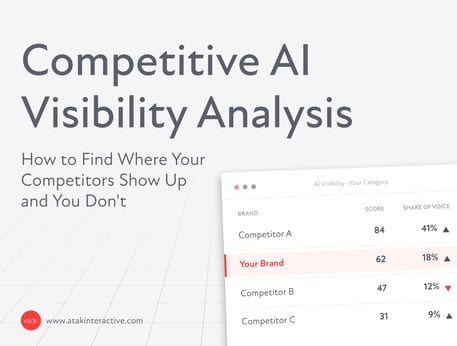
AI Visibility Score. Most platforms compute a proprietary 0-100 score that blends how often and how prominently you appear across AI answers. Top SaaS brands score around 84/100 in AI visibility, while the median sits at 62. Useful as a headline number, but only meaningful next to your competitors' scores.
Share of Voice. This is the one I'd anchor on. It's the percentage of brand mentions your company receives across AI responses relative to all brand mentions in your category. Divide your mentions by total category mentions, multiply by 100. A score of 18% means you show up in roughly one in five AI answers about your category. For benchmarks: in concentrated categories, market leaders typically hit 35 to 50% AI share of voice, while in fragmented markets, 15% or above is strong positioning.
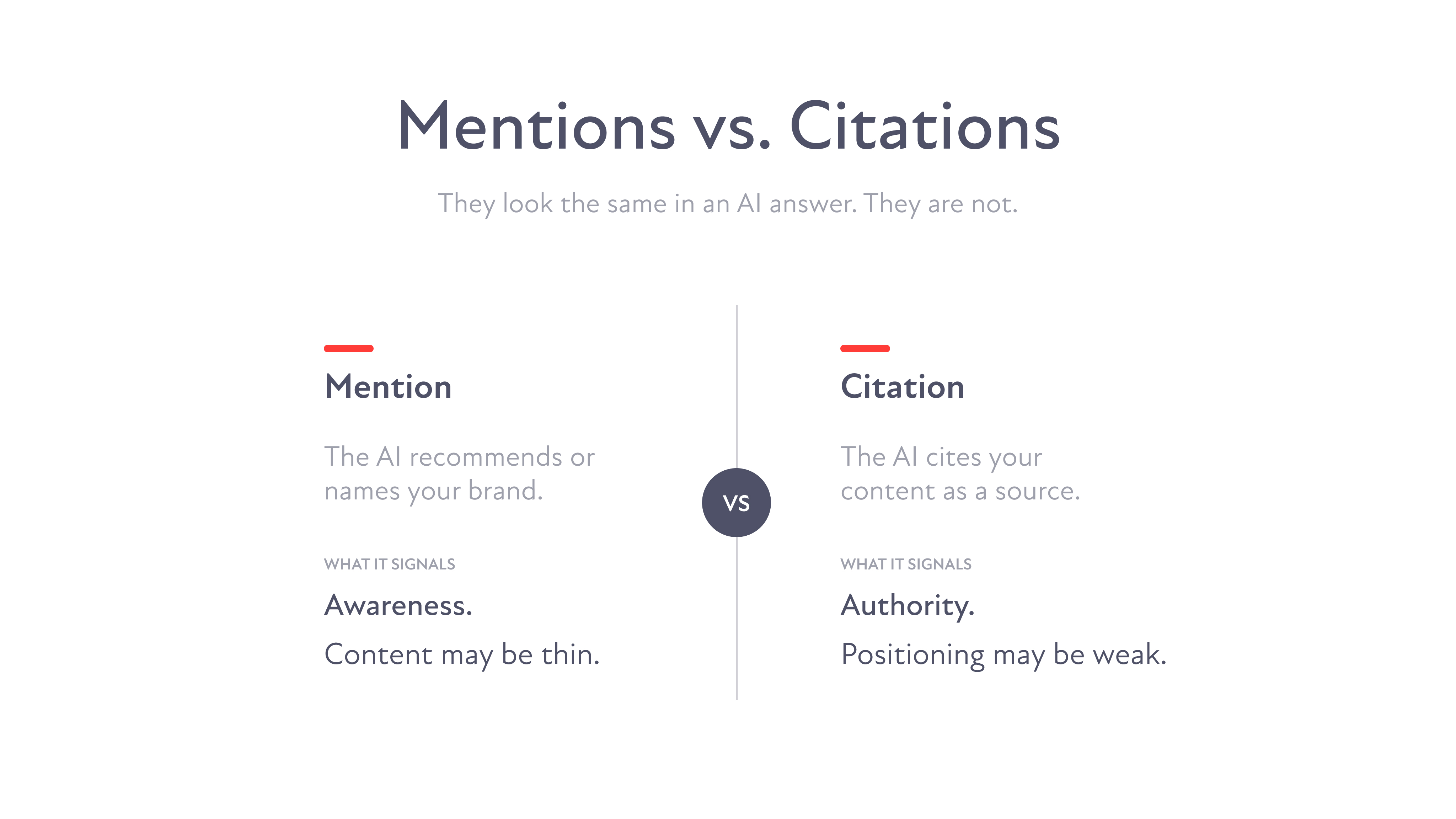
Mentions vs. Citations. These are not the same thing, and the gap between them is one of the most revealing signals you can find. A mention is the AI recommending or naming you. A citation is the AI pulling your content as a reference source. You can have one without the other, and which one you're missing changes your entire strategy.
Prompt Coverage. Of all the buyer-intent questions in your category, how many surface your brand at all? This tells you breadth, not just depth.
Sentiment. Showing up isn't enough; how you show up is the whole game. Sentiment analysis measures whether AI describes your brand positively, negatively, or neutrally, often on a scale from -100 to +100. And here's the uncomfortable truth: platform data across 200+ brands shows the average brand receives genuine endorsement on only 28% of the category prompts where it appears, with 41% neutral, 19% cautious, and 12% outright hallucinations. A competitor can outrank you in raw mention volume but carry a lower sentiment score, which means there's an opportunity to win on quality of perception even while you trail on quantity.
Platform Distribution. Mentions are not evenly spread. A Spotlight analysis of over 2.4 million AI responses found citation rates vary dramatically by platform: Perplexity and Copilot include external links in over 77% of responses, while ChatGPT does so in roughly 31%. Where you win and lose by engine should shape where you invest.
Geographic Concentration. Where are your mentions actually coming from? A brand that claims to be global but pulls 80%+ of its AI mentions from a single country has a positioning problem hiding in plain sight.
What This Looks Like in Practice
Let me make this concrete, because abstract metrics are easy to nod along to and hard to act on.
We recently ran a competitive AI visibility analysis in the assessment and organizational-effectiveness space. One brand we'll call QZ looked, on paper, like the obvious category king: a 20-year head start, named enterprise clients like McDon's and Unilever, over 1,000 peer-reviewed studies, and the strongest LinkedIn following in the space at 10,000+ followers. If you asked a customer in that market who the leader was, they'd say QZ without hesitating.
Then we looked at the actual AI visibility data. QZ scored 16/100, the lowest in the analysis. Its mentions were down 20.2% month over month, the steepest decline we recorded. Meanwhile, a much smaller, younger competitor was sitting at 20/100, growing, and already matching QZ on raw mention volume despite a fraction of the marketing infrastructure.
But here's the detail that reframed everything: QZ had 251 citations to the challenger's 41. Six times more. The AI engines were pulling QZ's research-heavy content as a trusted reference constantly. They just weren't recommending QZ as a product. QZ had a brand-awareness and recommendation problem sitting on top of genuinely strong content authority. The challenger had the opposite: weaker citation depth, but growing recommendation momentum.
Two competitors, nearly identical visibility scores, completely opposite problems and completely opposite strategies. You would never see any of that from a single-brand dashboard. It only appears when you map the whole landscape side by side.
You Can Find Competitors You've Never Heard Of
This is my favorite part, and it's the example that made me a believer.
I was talking with a customer about their competitive landscape recently, and they told me there was really only one serious player in their space besides them. Just the two of them, basically. So out of curiosity, I opened ChatGPT and asked it the kind of question their buyers would actually ask: "What are the best companies for manufacturing lamp shades?"
It was not two players. There were three competitors my customer had never heard of. And two of them had more AI market share than the "established" competitor my customer had been benchmarking against for years. These weren't fly-by-night operations either. They were quietly winning the AI shortlist while my customer was busy watching the wrong opponent.
That's the thing about AI-discovered competition. One of the most important principles of measuring share of voice is to keep the denominator open: manually defining a fixed competitor set inflates your relative score and blinds you to who's actually appearing. Let the data surface which brands really show up.
You can do a version of this yourself in an afternoon. Open ChatGPT, Gemini, and Perplexity. Ask the buyer-intent questions your customers ask: "best tools for X," "alternatives to Y," "who should I hire for Z." Note every brand that appears, every brand that gets cited, and the tone the model uses for each. Run each prompt a few times, because LLM responses vary across runs, so a single check misses mentions that appear intermittently. Multiple samples give you a true mention rate, not one noisy snapshot. Then ask the models directly how they'd describe each competitor, and you'll get a rough sentiment read for free.
That manual sweep is enough to tell you whether you're missing players. To do it at scale, with tracking over time and proper benchmarking, that's where tools like Semrush's AI Toolkit and HubSpot's AEO tool come in. HubSpot's tool, for example, will suggest prompts based on what it knows about your company, competitors, and industry, then show which domains, pages, and content types are showing up in AI answers for your category, so you stop guessing which questions to track.
From Landscape to Strategy: Closing the Gaps
Once you can see the board, the moves get obvious. Going back to that assessment-space analysis, the gaps practically wrote the strategy:
The challenger's biggest single weakness was that 6x citation gap. The play there is clear: long-form, research-backed content that AI engines pull as a source reference is the highest-leverage investment available. You close a citation gap by becoming citable.
The challenger was also already winning on ChatGPT specifically, where the incumbent had almost no presence. That's a lane you defend and extend, not one you fight for. Practitioner-focused content optimized for the platform where you already lead faces the least resistance.
And the incumbent's quiet liability, a poor employer-review profile that any procurement team would find, was a differentiator the challenger could lean into without ever saying a word. Sentiment and reputation gaps in AI work the same way. When you find a competitor being described with caution or carrying negative associations, that's not just their problem; it's your opening.
The Bottom Line
You cannot understand your position in a market you can't see. For years, "the market" meant Google rankings and a handful of competitors you already knew about. That definition is now incomplete and, frankly, a little dangerous. Your buyers are forming opinions inside AI answers you've never read, comparing you to companies you've never heard of, before they ever land on your site.
The good news is that this is all visible now. Run the prompts. Map the landscape. Find the brands you're missing and the gaps your competitors are leaving open. The companies that win the next few years won't be the ones with the longest history or the biggest follower count. They'll be the ones who saw the whole board first and moved while everyone else was still checking their own score.
FAQs