Table of Contents
A prospect found us through a YouTube video. Then they read three blog posts. Then they went quiet for six weeks. The next thing we heard was a reply to a LinkedIn post, "we've been following your stuff for a while, can we talk?"
By the time that conversation happened, the deal was halfway closed. Not because of anything we said on the call. Because of everything they'd already absorbed before the call existed.
That's the part most B2B teams still get wrong. They treat Google, YouTube, LinkedIn, and now AI search as four separate jobs with four separate calendars and, too often, four slightly different versions of what the company actually believes. The buyer doesn't experience it that way. They experience one company or one blur. And a blur doesn't get the call.
More Channels, More Problems
McKinsey's B2B Pulse research found buyers now use an average of 10 interaction channels across their buying journey, up from just 5 in 2016 (and that's before you count the AI tools doing research on their behalf). At the same time, Forrester's Buyers' Journey Survey found 92% of B2B buyers already have at least one vendor in mind before they start formally evaluating options.
Sit with those two facts together. Buyers are touching you in more places than ever, and the winner is usually decided before anyone fills out a form. Which means every place they touch you is doing positioning work whether you planned it or not. The blog isn't "top of funnel." The YouTube video isn't "brand awareness." They're all auditions for the shortlist, happening in parallel, often months before you know the buyer exists.
So the question stops being "how much content can we produce?" and becomes "does our content say the same thing, no matter which door they walk through?"
Content is not king when the king is shouting into an empty forest
Many times, content is a giant waste of time. Not because it's badly written. Because it's homeless. It gets published, it gets indexed, and it sits there saying nothing memorable to no one in particular. Volume without a point of view is just noise with good grammar.
A real point of view is the opposite of safe. It should repel the wrong buyers as efficiently as it attracts the right ones. You're not trying to be agreeable to everyone, you're trying to be unmistakable to a specific someone. When a CMO reads your blog, watches ninety seconds of your video, and scrolls past your LinkedIn post, those three moments should feel like the same person or brand talking. Same conviction. Same worldview. Same way of seeing the problem.
The opposite — different messages on different platforms — is where most brands unintentionally self-sabotage. The blog is about one thing, the videos are on something else, LinkedIn chases whatever's trending that week. Each channel might be individually fine. Together they cancel out. The buyer can't form a clear picture of what you stand for, so they don't form an attachment, so you stay a vendor instead of becoming the vendor.
This isn't a soft "brand" argument. The pattern shows up in the revenue data too. Multiple marketing-effectiveness studies put the revenue lift from consistent cross-channel brand presentation somewhere in the 10–23% range, and the more telling stat is the gap on the supply side: by some counts, fewer than 10% of B2B companies say their branding is fully consistent across channels. I'd treat the exact percentages as directional. They age fast and the methodologies vary. But the direction is the durable truth: consistency compounds, fragmentation leaks, and almost nobody is actually doing it. That last part is the opportunity.
Same message, different physics on each platform
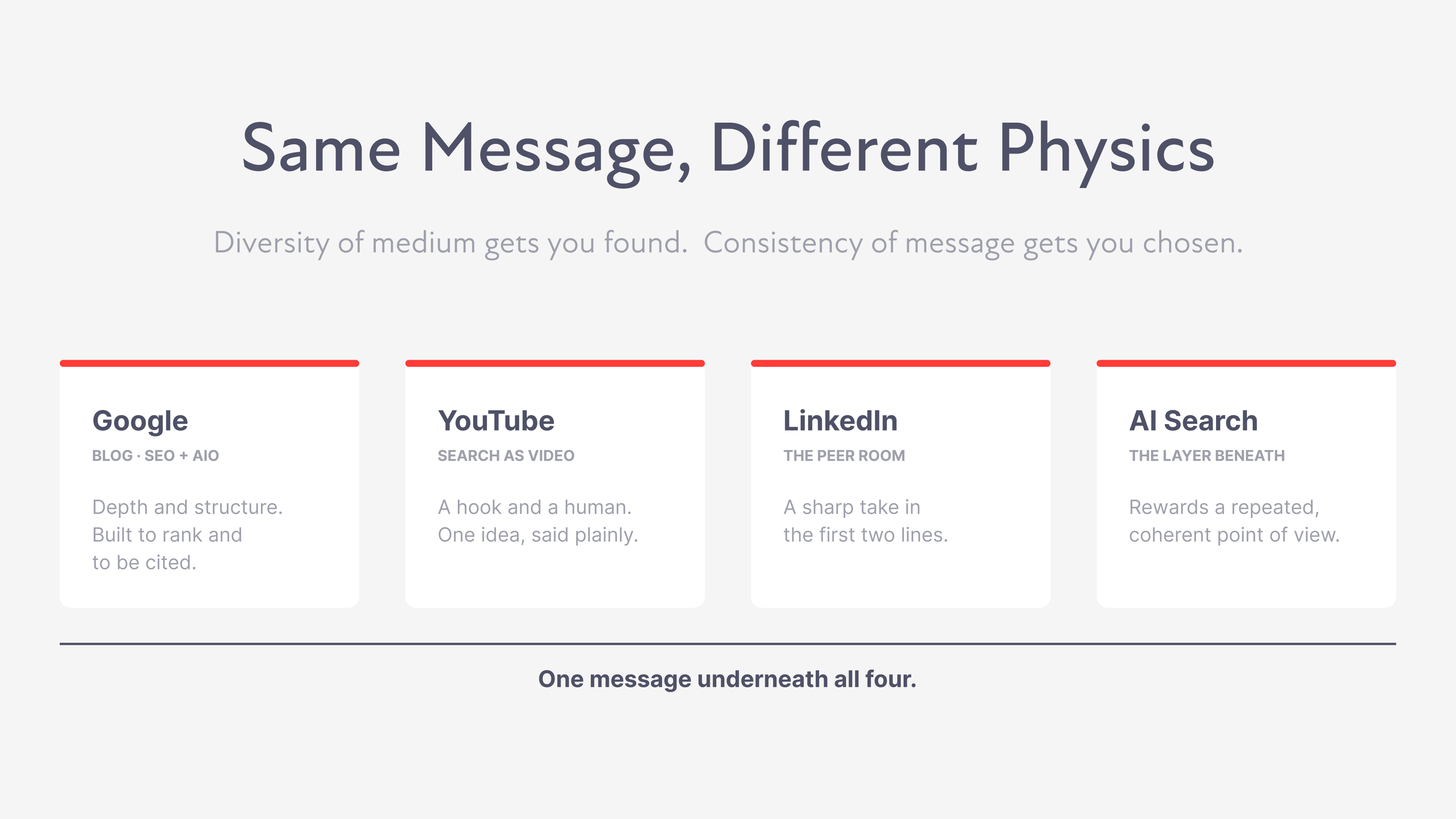
Here's the nuance that trips people up. "Consistent message" does not mean "same post copy-pasted four ways." Each platform has its own physics. You earn visibility differently in each. The message stays fixed; the mechanics flex.
Google is written for SEO and AIO at the same time. This is still your deepest real estate - the place a buyer goes to do the long, careful research B2B demands. But the job has split in two. You're writing for the buyer who clicks through and for the AI systems that read your page and decide whether to cite you in an answer. That means structure does double duty: clear, declarative topic sentences that state your position in the first line of a paragraph, definitions that stand on their own, and entities named explicitly instead of hidden behind "it" and "this." Write the paragraph an AI could lift verbatim into an answer and have it still make sense — and still sound like you. The blog is where your point of view gets its longest, most defensible expression.
YouTube is just search disguised as entertainment. People forget YouTube is the second-largest search engine, not just a video host. B2B buyers go there to watch a face explain the thing before they trust the brand behind it. The physics here reward the hook (you have seconds), the human (a real person, not a logo), and the clarity (one idea per video, said plainly). The mistake is treating video as a different message, many times a looser, jokier, off-brand version of the company. Don't. Same point of view, delivered through a medium that lets buyers feel like they already know you before you've met.
LinkedIn is the room where peers talk directly each other. This is the channel where your old colleague tags you in a post, where a buyer's boss reshares something and the buyer sees it secondhand. It runs on punchy, opinionated, native-feeling posts. Not press releases, not blog links with a one-line caption. The physics reward a strong take in the first two lines and a willingness to say something a competitor wouldn't. Again: same conviction as the blog, compressed and conversational.
AI search is the layer underneath all three. Even if much of it mirrors traditional SEO, it’s worth naming on its own, because it's now reading everything above and synthesizing an answer about you. The thing that makes AI cite you consistently is the same thing that makes a human trust you: showing up with a coherent, repeated, well-structured point of view across multiple sources. Consistency isn't just a brand nicety to the models - it's a reliability signal. Say the same true thing in enough credible places and you become the answer.
Four channels. Four sets of mechanics. One message underneath all of them.
Organize Your Content Calendar
Now the practical part, the thing we actually all need to crack, even if our paths all vary. Everyone uses a different stack. Some teams live in Asana or Monday, some in Notion, some in a Google Sheet held together with hope. So I'm not going to hand you a tool. I'm going to hand you a structure you can rebuild in any of them in about twenty minutes.
Here's the core insight, and it's almost embarrassingly simple: most content calendars are organized by channel, and that's exactly what fragments the message.
Think about how a typical calendar is built. There's a blog tab. A social tab. A video tab. Maybe a different owner for each. Each tab fills up independently. Nobody's job is to make sure the blog, the video, and the LinkedIn post are the same idea. So they drift. Of course they drift, the structure was designed to let them.
Flip it. Organize the calendar by idea, not by channel.
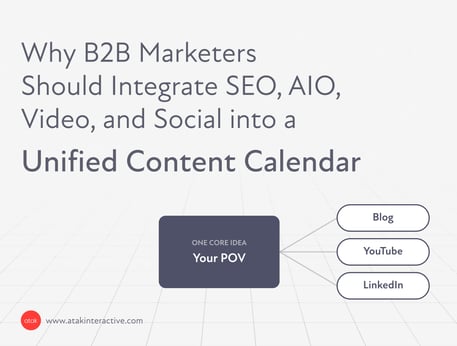
One row equals one core idea that reflects a single piece of your point of view. The columns are the channels that idea expresses itself through. Like this: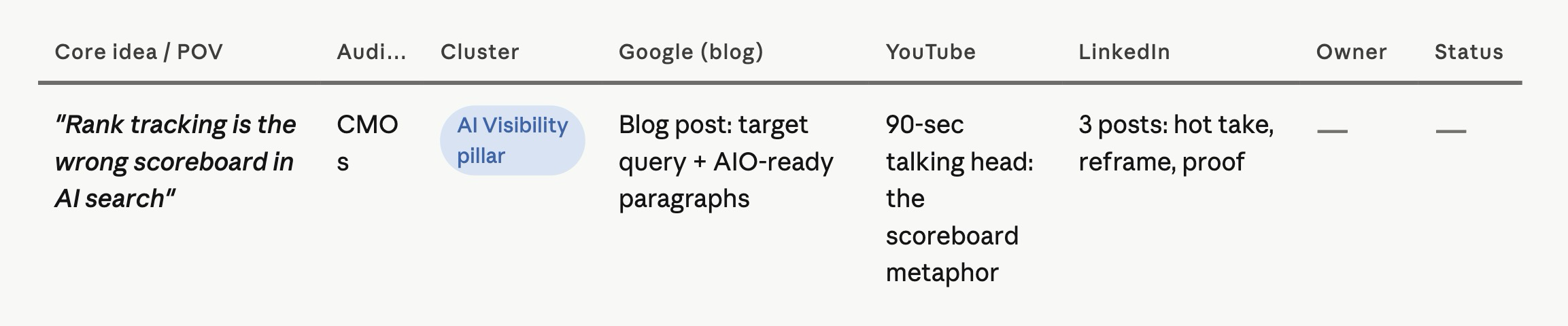
Read across that row. Same idea, three expressions, one through-line. The blog makes the full argument and gets built to be both ranked and cited. The video delivers the single most memorable line from that blog as a human, on camera. The LinkedIn posts strip it to its sharpest take. Nobody has to remember to keep them aligned - alignment is baked into the shape of the row.
A few rules that make this hold up in the real world:
- The "Core Idea" column is sacred. If you can't write the idea as one clear sentence with a real point of view, it's not ready to go anywhere. That cell is the quality gate for everything to its right.
- Sequence beats simultaneity. You don't have to ship all three the same day. The blog can anchor the cluster, the video can follow a week later, LinkedIn can drip over the next month pointing back. The buyer's journey is months long — your calendar can be too.
- Cluster, don't scatter. Group the rows into the content clusters that support a specific product or service, so a buyer who finds one door finds a whole house behind it. (More on this in a second.)
- Status per channel, not per row. The blog might be live while the video's still scripted. Track each cell's status independently so you can see the gaps.
That's it. It works in a spreadsheet. It works in Notion. It works in your PM tool of choice. The magic isn't the software, it's that the unit of planning is now the idea, which is the only thing that was ever supposed to be consistent in the first place.
Why the clusters matter
Back to that buyer from the opening. The reason the multi-channel thing worked isn't that we were everywhere. It's that everywhere they looked, the content connected to more content that said the same thing, deeper. The YouTube video led to a blog. The blog sat inside a cluster of related blogs. Every step reinforced the last. That's an orbit, and once a buyer's in it, the pull does the selling for you.
That structure - which ideas become pillars, which become supporting pieces, how they link, and how they ladder up to the product or service you're actually selling - is the part that's easy to get wrong and expensive to redo. It's the core of what we do inside ATAKSearch: mapping the content clusters that build genuine topical authority, so the calendar you just built isn't a pile of one-off posts but a connected system designed to get found and understood across Google, YouTube, LinkedIn, and AI. The calendar is the engine. The cluster map is the blueprint that tells the engine where to go.
The whole point, in one line
You don't win B2B by shouting louder on more channels. You win by making sure that no matter which door a buyer walks through, they meet the same conviction, delivered in the way that channel rewards. Diversity of medium widens your chances of getting found. Consistency of message turns getting found into getting chosen.
Build the calendar around the idea. The channels are just how the idea gets out.
FAQs