Table of Contents
The evolution from keywords to content clusters seemingly happened fast. One day you were focused on an exact title and trying to get your point across tying in a few specific words and the next day you were free to write about what you loved in your own voice without having to worry about how Google’s algorithm would respond.
That’s because brands win in 2026 by building content clusters: deep, interconnected bodies of work that establish genuine authority over an entire area of expertise. Now you may hear "content cluster" and think it's just a fancier SEO tactic. It’s not. Your goal is not just to rank. It's getting a buyer so intrigued by one article that they click to the next, then the next, until they've spent an hour inside your thinking and feel like they already know you.
When it's finally time to reach out, they're not requesting a demo from a stranger. They're excited to talk to the person that taught them all of this exciting new information.
Content is just one form of marketing. And if you’ve read anything I’ve written the past decade, you know the marketing needs to lead to sales. So let’s dive in. How do we go from content clusters to new customers?
Let me show you how it works.
What a Content Cluster Actually Is
Let's define this clearly because the term gets thrown around loosely.
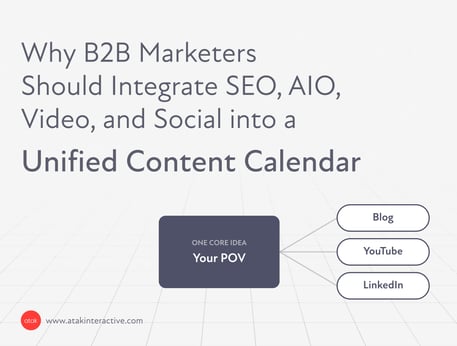
A content cluster is an organized body of content built around one central theme. It has two parts. The pillar page is the hub: a comprehensive, high-level resource covering a broad topic you want to own (think "The Complete Guide to B2B Demand Generation"). Then you have cluster pages: a network of more specific articles, each diving deep into one subtopic, comparison, or question within that theme. Every cluster page links back to the pillar, and the pillar links out to all of them.
Think of it as building a web of context, not just a web of links. That distinction matters more than ever. In 2026, this two-way linking structure does more than satisfy search crawlers. It creates a semantic map that helps both traditional search engines and AI answer engines understand how your content is organized and which pages are most authoritative on a given topic.
The mechanism underneath it all is topical authority: the signal that tells both search engines and AI answer engines that your brand owns a subject area. One brilliant article can't prove you own a topic. Twenty interconnected articles that cover every angle of it can. A site with 20 interconnected articles on email marketing will consistently outrank a site with one 5,000-word guide, even if that single article is technically superior. Depth and breadth across a topic beat density on a single page, every time.
So the unit of strategy has changed. You're no longer asking "what keyword do I want to rank for?" You're asking "what subject do I want to be the recognized authority on?" That's a bigger, more creative, and far more durable question.
The Data Behind the Shift
The numbers on cluster-based content are genuinely hard to argue with.
The traffic lift shows up consistently across sources. Cluster strategies have been associated with roughly 30% more organic traffic, 2.5 times longer-lasting rankings, and 4.7 times more link equity flowing to priority pages. Sites that sustain cluster publishing for 12 or more months see around 40% higher organic traffic than comparable single-page strategies. Different agencies report similar ranges, with some client cohorts seeing organic traffic growth in the 46 to 51% range within six months of implementing clusters, alongside meaningful jumps in average keyword rankings per cluster.
But the stat that should reframe how you think about this is the AI one. Content clusters have been shown to lift AI citation rates from around 12% to as high as 41%. That's the difference between an AI engine occasionally stumbling onto your content and an AI engine treating you as a go-to reference for an entire topic. In a world where buyers research through ChatGPT and Google's AI features before they ever hit your site, that's not a nice-to-have. That determines whether you exist in the conversation at all.
There's also a structural reason clusters are winning now, and it's worth naming. When every brand can generate a 2,000-word article in seconds, generic information has effectively been commoditized. The marginal value of another "how-to" guide is close to zero. The bar has risen sharply. A cluster article that cites original data, proprietary research, or firsthand testing earns backlinks and AI citations that a rehashed generic article simply does not. Volume alone is dead. Depth wins. And depth is exactly what a cluster is built to deliver.
The Cycle: Get Found, Resonate, Convert
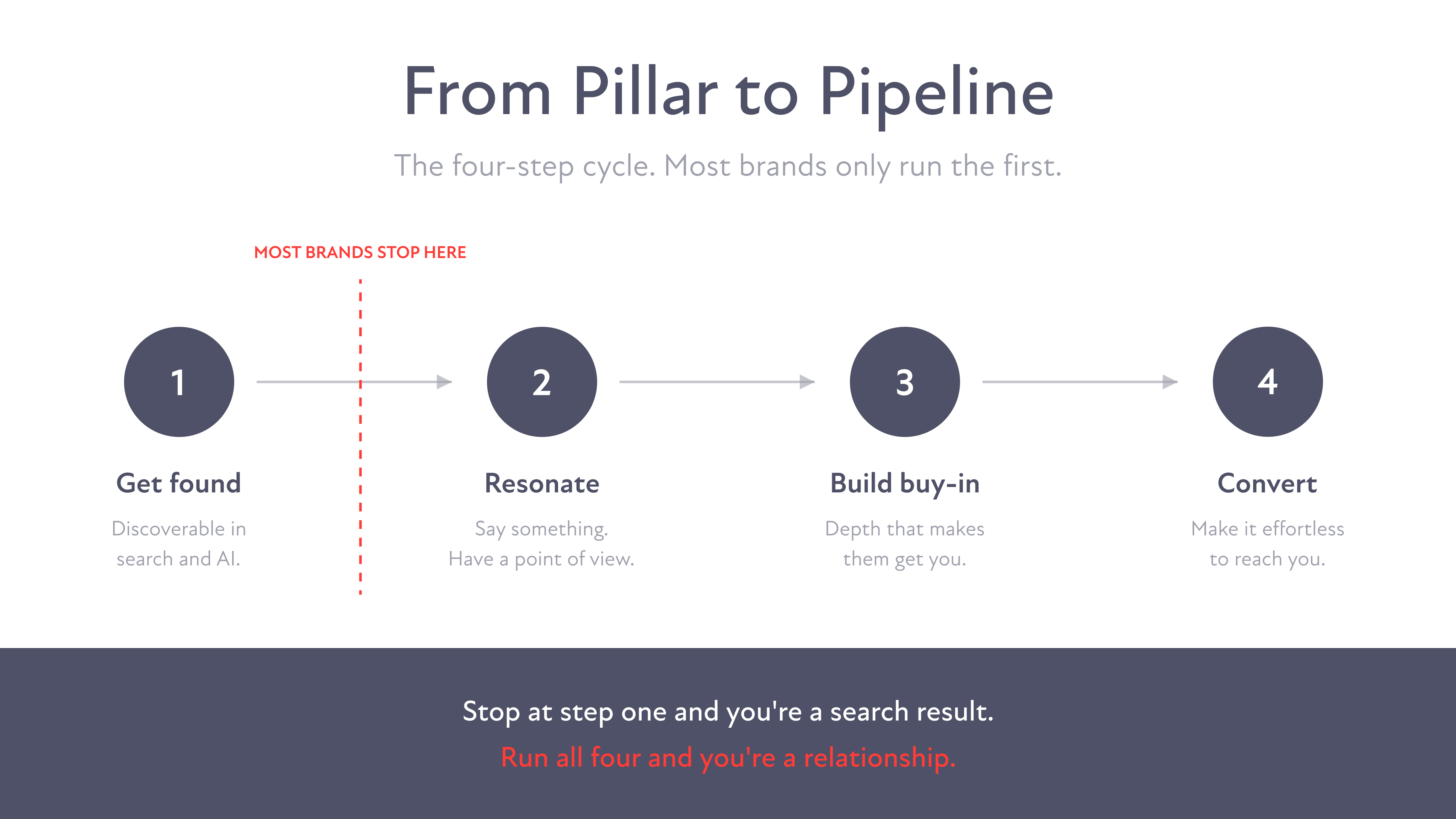
Here's how I think about what a cluster is actually supposed to do. It's a four-step cycle, and most brands only ever execute the first step.
Step 1: Get found. This is the table-stakes part. Your cluster architecture, your internal linking, your topical authority. All of it makes you discoverable across both traditional search and AI answer engines. This is the part everyone optimizes for.
Step 2: Explain your point in a way that excites and educates. This is where almost everyone stops short, and it's the most important step. Getting found is worthless if what the reader finds is forgettable. You have to say something. You have to have a take.
Step 3: Be so thorough the reader fully buys in. This is where the cluster's depth pays off. When a prospect can explore eight, ten, fifteen articles that all reinforce a coherent worldview, they don't just understand your product. They understand you. They've internalized your way of seeing the problem. By the time they're done, you've eliminated weeks of vendor education that would otherwise happen in sales calls.
Step 4: Make it absurdly easy to reach you. Meet buyers exactly where they are in the moment they're ready. A calendar booking link for the ready-to-talk. A form fill for the still-researching. A phone number for the urgent. Live chat for the impatient. Don't make a warm prospect hunt for the door.
That cycle is the engine that turns a content library into pipeline. The return on this kind of content is no longer traffic alone. It's pipeline velocity. When prospects already recognize your perspective and credibility, they move from awareness to decision significantly faster. The proof is in the conversion data: companies with active thought leadership see 2.7x more qualified leads, and those leads close at a 34% higher rate because the buyer already trusts them before the first conversation.
Why Being Lukewarm Is the Real Risk
Now here's the part that scares people...
The freedom content clusters give you, all that room to write around a whole subject instead of one keyword, is wasted if you use it to sound like everyone else. And most brands do. 68% of B2B buyers think all brands look and sound the same. Sixty-eight percent! That's not a content problem. That's a courage problem.
The fix is to write with an actual point of view. To have opinions. To take a stance that some readers will disagree with. This feels dangerous, and that's exactly why so few brands do it, which is exactly why it works.
I keep coming back to Seth Godin's old line: "people like us do things like this." It explains much of modern marketing. Political elections run on it. The old Mac vs. PC ads pioneered it. It's why you buy the clothes you buy, the software you pick, the brands you defend at dinner parties. You're constantly being invited to connect with the psychographic of a brand, to see yourself in alignment with something bigger than a product or service. You don't make purchases on specs alone. You choose the ones that feel like they're for people like you.
Now apply that to your content clusters. If every article you write is as neutral as a Wikipedia entry, you can only ever achieve Step 1. You'll get found. But you won't resonate, you won't be remembered, and you definitely won't earn that parasocial trust that makes a prospect excited to talk to you. You'll be a search result, not a relationship.
Writing with a point of view means accepting that you'll push some people away. Good. Let them go. They were never going to be great-fit customers anyway. In saturated B2B markets where your product looks a lot like the competition, a genuine perspective is the differentiation, because you're offering a way of thinking prospects can't find anywhere else. The buyers who do connect with your take will connect harder, trust faster, and arrive at the sales conversation already sold.
So take advantage of the creative room a cluster gives you. Don't just build content that helps you get found. Build content that helps you get understood.
Building Clusters That Actually Work
A few hard-won principles for doing this well, because the gap between a cluster on paper and a cluster that performs is mostly execution.
Build the pillar first. Publishing cluster articles before the pillar exists means months of pages that can't link back to anything, and you lose the authority-building benefit of those return links from the start. The pillar is the anchor; pour it first.
Build in thematic batches. Rather than publishing one article per month scattered across several clusters, complete one full cluster (all 8 to 12 articles) before starting the next. This concentrates the topical authority signal and produces faster ranking results. For most topics, 8 to 15 cluster pages is the practical range, and the right number is whatever it takes to cover the full set of subtopics your buyers are actually searching for.
Keep it fresh. A pillar written in 2024 and left untouched sends a freshness signal that quietly erodes the whole cluster's authority, so the best teams refresh their pillar on a quarterly or semi-annual schedule.
And build around audience intent, not vanity topics. Building clusters around topics you wish people searched for, rather than what they're actually looking for, is one of the most common ways these strategies fail.
The Bottom Line
The shift away from keyword-by-keyword content is the best thing to happen to creative, opinionated marketers in a decade. It rewards depth, rewards a real perspective, and rewards brands willing to actually say something.
Build the cluster. Cover the topic so thoroughly that you become the obvious authority. Write it with enough point of view that the right buyers feel like they've found their people. Then make it effortless for them to reach you. That's the path from pillar to pipeline, and the brands that walk it won't just get found. They'll get chosen, before a sales rep ever picks up the phone.
FAQs