Table of Contents
Throughout 2025, I got this question repeatedly - how do I get seen in more ChatGPT searches?
While the answer can be quite complex, the question kept popping up because my clients’ own search behaviors were changing and they understood if they were searching in a new context, their customers must be as well.
So let’s try to answer this specific question with as best a breakdown as we can, shall we?
First, Let us Be Clear About What Getting Cited Actually Means
There's an important distinction most people skip over.
When ChatGPT answers a question without browsing the web, it draws on training data and may mention your brand by name. That's a mention. When it actively searches the web and references your page as a source, complete with a link that's a citation.
Citations are what you want. They drive referral traffic. They signal authority. And they're measurable.
About 18% of ChatGPT conversations trigger at least one web search, according to Profound's analysis of 730,000 ChatGPT conversations from late 2025. That number seems small until you do the math: ChatGPT processes 2.5 billion prompts every day. 18% of that is a lot of conversations where someone's content gets surfaced — or doesn't.
The question isn't whether there's an opportunity. The question is whether your content is built to win it.
There's No Silver Bullet. But There Is a Formula.
Let's get this out of the way upfront: there is no guaranteed path to a ChatGPT citation. ChatGPT doesn't publish a rulebook. The algorithm isn't a checklist. And what works in one niche won't automatically work in another.
But the data is clear that certain structural and content choices dramatically increase your odds. Think of it less like a formula and more like a batting average. These are the things that make your content significantly more likely to get cited — and none of them alone is enough. Together, they stack.
Here's what the research shows actually moves the needle.
The 5 Elements of a Citation-Worthy Paragraph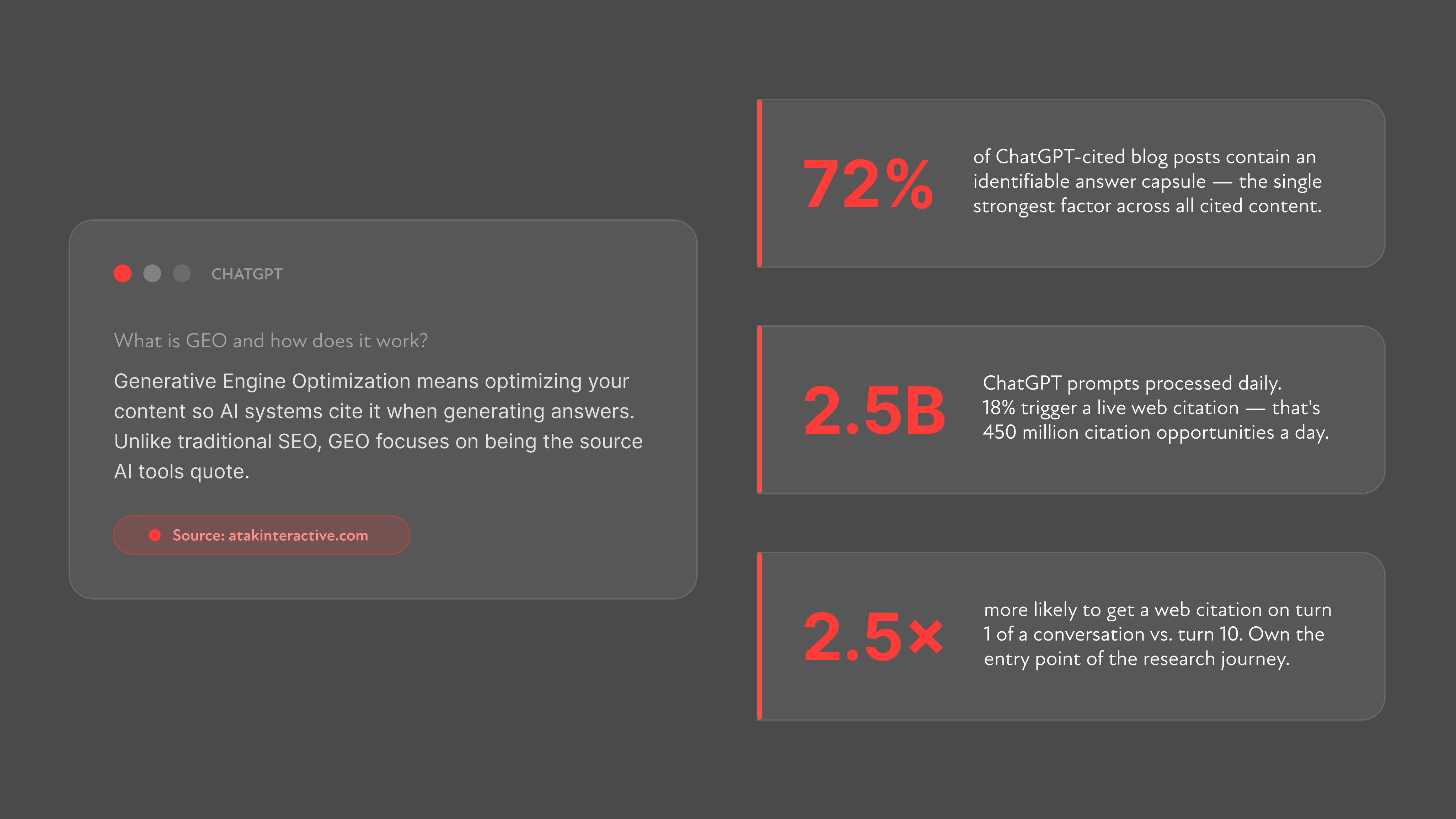
1. The Answer Capsule (The Single Biggest Factor)
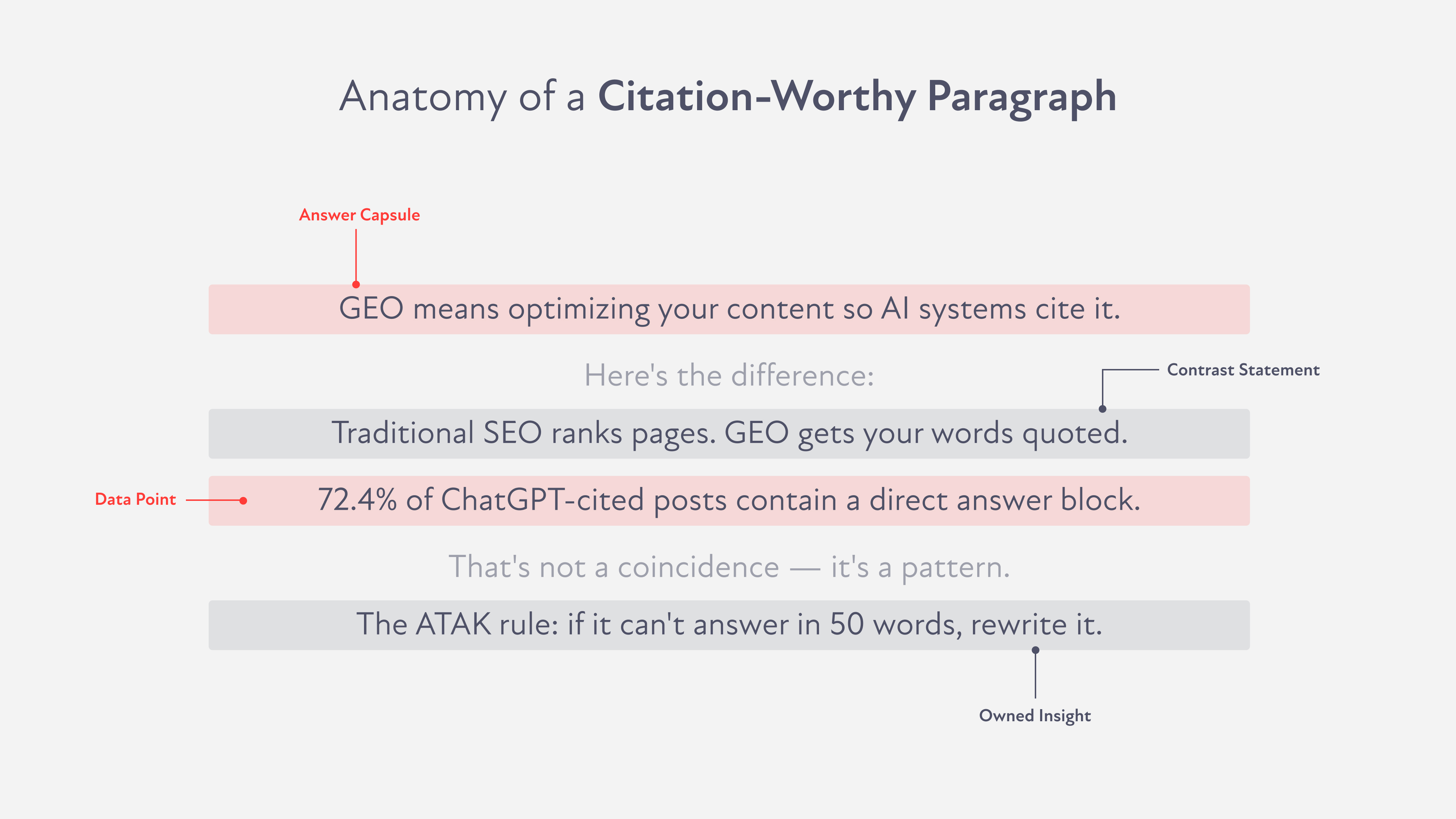
An answer capsule is a short, self-contained block of content that directly answers a specific question. It's 2-4 sentences, plain language, no links, no meandering — just a crisp answer that could stand alone.
Search Engine Land's audit of 15 domains across nearly 2 million organic monthly sessions found that 72.4% of blog posts cited by ChatGPT included an identifiable answer capsule. That's the single strongest commonality across all the cited content they studied.
Why does it work? Because ChatGPT is, at its core, trying to answer a question. When your content contains a clean, extractable answer block, you're doing the AI's job for it. You're handing it exactly what it needs.
What a weak opening looks like:
"In today's fast-paced digital landscape, many factors contribute to content marketing success. Let's explore the various dimensions of what it means to create effective strategies..."
What an answer capsule looks like:
"GEO (Generative Engine Optimization) means optimizing your content so AI systems cite it when generating answers. Unlike traditional SEO, which focuses on rankings, GEO focuses on being the source AI tools quote."
One of those gets cited. The other gets skipped.
The rule: Lead every major section with a direct answer. 40-60 words, maximum. State the thing. Then expand.
2. Specific Data Points (The More, The Better)
Vague content doesn't earn citations. Specific, factual content does.
SE Ranking analyzed 129,000 domains and found that content with 19 or more statistical data points averaged 5.4 ChatGPT citations — nearly double the 2.8 average for content with minimal data.
ChatGPT is built to cite factual claims. When it surfaces a stat, it wants to point back to the source that produced it. If your content is full of numbers, studies, and specific data — and you sourced them properly — you become a citation target.
The corollary: content that leads with generalities, adjectives, and undifferentiated advice gets ignored. "Many businesses are seeing great results" is not citable. "73% of businesses that implemented X saw a 40% reduction in Y within 6 months" is.
Original data performs even better. When you cite your own surveys, your own client data, or your own research — you own a fact nobody else can reproduce. That uniqueness is exactly what AI tools are looking for.
The rule: Anchor every major claim to a specific number. If you don't have one, find a credible study. If you can run original research, even at a small scale, do it. Own at least one fact per section that nobody else has.
3. Branded Owned Insights (The Underrated Differentiator)
This one surprises people.
Owned insights are claims where your brand's name or framing is attached to the interpretation. Not just "here's a stat from a study" — but "here's what WE believe that means, and here's our branded take on it."
It sounds like this: "The ATAK rule of thumb: if your content can't answer a question in 50 words, it's not organized for AI. Rewrite the opening of every major section until it can."
The aforementioned Search Engine Land audit found that 34.3% of cited posts combined both an answer capsule AND original or owned insight — the strongest-performing configuration in the entire study.
Why? Because AI tools are looking for expert perspective, not just aggregated information. When you frame a claim as yours — with your name attached — you create a citation hook. The model learns to associate that framing with your brand as a source.
The rule: Give your perspective a name. "The ATAK approach," "our take," "what we've found with clients." This isn't about ego, it's about creating a linguistic anchor the model can attach to.
4. Structure That AI Can Parse
ChatGPT doesn't read like a human. It parses. And it parses structure.
SE Ranking's analysis found a specific sweet spot: pages with 120 to 180 words between headings averaged 4.6 citations — significantly higher than sections under 50 words (2.7) or long unbroken walls of text.
That's not arbitrary. It reflects how well-organized expert content actually reads. Short enough to be scannable. Long enough to be substantive. Each section a complete thought.
Content length matters too — but probably more than you think. Articles over 2,900 words averaged 5.1 citations. Articles under 800 words averaged 3.2. Depth signals authority. Thin content doesn't earn citations.
One counterintuitive finding worth noting: pages with highly keyword-optimized titles averaged only 2.8 citations, compared to 5.9 for titles with broader, topic-describing language. ChatGPT isn't doing keyword matching. It's doing semantic relevance. Write your headlines for comprehension, not for a keyword density tool.
The rule: Aim for 120-180 words per section. Use clear H2 and H3 headers that describe the topic, not target a keyword. Write long enough to be comprehensive. Not longer.
5. The "First Question" Strategy
Here's the most tactical finding…and the most underutilized.
Profound's analysis of 730,000 ChatGPT conversations found that the first turn of a conversation is 2.5x more likely to trigger a web citation than turn 10, and 4x more likely than turn 20. Citations concentrate at the start of research journeys, not the middle.
What does that mean for your content? Target the questions people ask before they know exactly what they want.
"What is GEO?" before "How do I implement GEO for a B2B SaaS company." You see it all the time with recipes – "What is lasagna?" before "What ingredients are crucial to a great lasagna?”
These broader, earlier-stage questions are where citations happen. Your content needs to be built for the moment someone starts researching your category, not just the moment they're ready to buy.
The rule: For every piece of cornerstone content, ask yourself: "What question does someone ask in ChatGPT before they'd ask what this page answers?" Create content for that upstream question. Own the entry point.
A Real-World Breakdown: Why This Blog Gets Cited
We're going to do something a little different here and use our own content as the example, because it's one we can speak to directly.
Our blog post — SEO vs. GEO vs. AEO vs. AIO: What Actually Matters in 2026 — has performed well not just in traditional search but in LLM citations. Here's why, looking at it through the lens above.
Take the opening of the GEO section:
"Generative Engine Optimization means optimizing so AI systems actually cite your content when generating answers. Here's the difference: Traditional search engines link to sources. Generative AI synthesizes information and delivers direct answers."
That's a textbook answer capsule. A clean definition, a direct contrast, under 50 words. ChatGPT can extract that and use it verbatim to explain GEO to a user.
Then immediately below it, the section drops into tactics with specific subheadings like "Answer Questions First, Expand Later" — exactly the kind of labeled structure that makes individual sections independently parseable. A reader (or an AI) can navigate directly to the specific answer they need.
The blog also uses specific data points throughout: "Google processes 8.5 billion searches per day. BILLION." That specificity creates citation hooks. It's not "Google processes a lot of searches." It's a number. Numbers get cited.
That combination — clear definitions, specific data, well-structured sections, comprehensive depth — is the formula. It's not complicated. But it takes discipline and, admittedly, a little luck.
What Doesn't Work (Even Though Everyone Thinks It Does)
A few counterintuitive findings worth flagging, because they'll save you wasted effort.
FAQ schema markup underperforms. SE Ranking's data found pages with FAQ schema averaged just 3.6 citations — below average. The schema signals intent, but it doesn't substitute for the quality of the answer itself. Mark up your FAQs if it helps your structured data strategy. Don't expect it to be your citation shortcut.
High keyword optimization in titles backfires. As noted above, tightly keyword-matched titles actually correlated with fewer citations. Write descriptive titles that signal the topic clearly. Leave the keyword stuffing to 2008.
Domain extension doesn't carry the weight you'd think. .gov and .edu domains averaged just 3.2 citations — lower than commercial .com sites at 4.0. What matters is content authority, not domain type. Your well-researched, well-structured blog post can outperform a government website if it's better organized and more directly useful.
Page-level authority matters less than domain-level. SE Ranking found that once a page crossed a Page Trust score of 28, citation rates plateaued. ChatGPT is weighing your domain's overall authority more than the individual page's link profile. Which means the best investment is building your site's overall credibility — not chasing links to individual pages.
How to Audit Your Existing Content in 30 Minutes
Before you rewrite everything, start here.
Step 1: Pick your five highest-traffic pages. These already have authority signals working for them. Improving their citation-readiness is the fastest win.
Step 2: Check the opening of each major section. Can you extract a 40-60 word answer to the section's implied question? If not, add one above the fold of each section. This alone — adding answer capsules — is the single highest-leverage edit you can make.
Step 3: Count your data points. Aim for at least 8-10 specific stats or data references per long-form post. Under that, you're relying on generalities. Over that (especially 19+), you're building a citation-dense resource.
Step 4: Search your core topic in ChatGPT. See what sources it cites. Those are your citation neighbors. Profound's research found that sources travel in packs — ChatGPT co-cites a consistent cluster of sources on any given topic. Identify who's in your cluster and understand why they're there.
Step 5: Add at least one owned insight per section. Even if it's small. "Our recommendation," "what we've found," "the way we think about this." Create the linguistic anchor.
The Bottom Line
There's no magic paragraph that guarantees a ChatGPT citation. Anyone who tells you otherwise is selling something.
What there is: a set of structural habits and content choices that make your writing significantly more extractable, more citable, and more useful to the AI systems your audience is already using to research before they ever contact you.
Answer the question first. Be specific. Own a perspective. Structure for parsing. Target the entry point of the research journey.
Do all of that consistently across the content library (not just one post), and you start building the kind of topical authority that earns citations at scale.
FAQs