Table of Contents
On May 15, 2026, Google published an AI Optimization Guide on its Search Central site, and it settled a question the industry has been arguing about for two years. GEO and AEO aren’t separate disciplines. In Google’s framing, they’re SEO.
That doesn’t mean AI visibility doesn’t matter. It matters a lot. It means the work belongs inside your SEO strategy, not in a separate retainer with its own playbook of tricks. Google’s guidance also gives you a clear way to sort the AI visibility work that moves the needle from the tactics that were always more pitch than substance.
The guide sits in the same documentation Google uses for crawling requirements, spam policies, and structured data specs. That makes it the closest thing to an official position Google publishes.
Here’s what changed, what didn’t, and what your marketing team should do about it.
What Google Actually Said
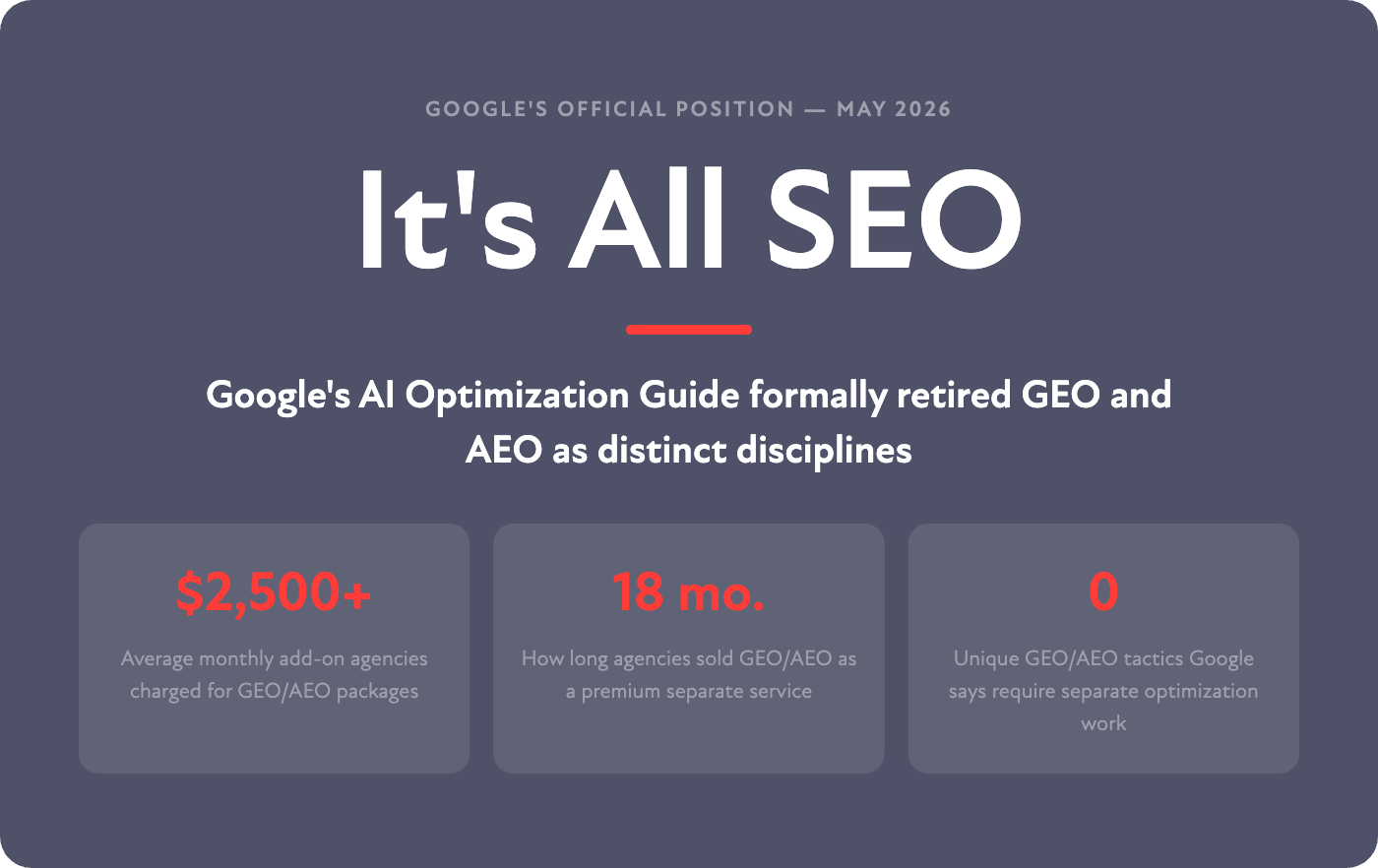
The guide addresses the terminology head-on. From Google’s perspective, optimizing for generative AI search is optimizing for the search experience, so it’s still SEO.
It also names tactics site owners can ignore for Google Search, several of which have been packaged as GEO and AEO deliverables. These include chunking content, creating llms.txt files, and pursuing inauthentic mentions.
Pay attention to the scope. Google is talking about its own surfaces: traditional search, AI Overviews, and AI Mode. It isn’t speaking for ChatGPT, Perplexity, or Claude, which find and cite content in their own ways. That’s one reason AI visibility still deserves real attention. It just doesn’t need to be its own discipline.
The Tactics Google Says You Can Skip
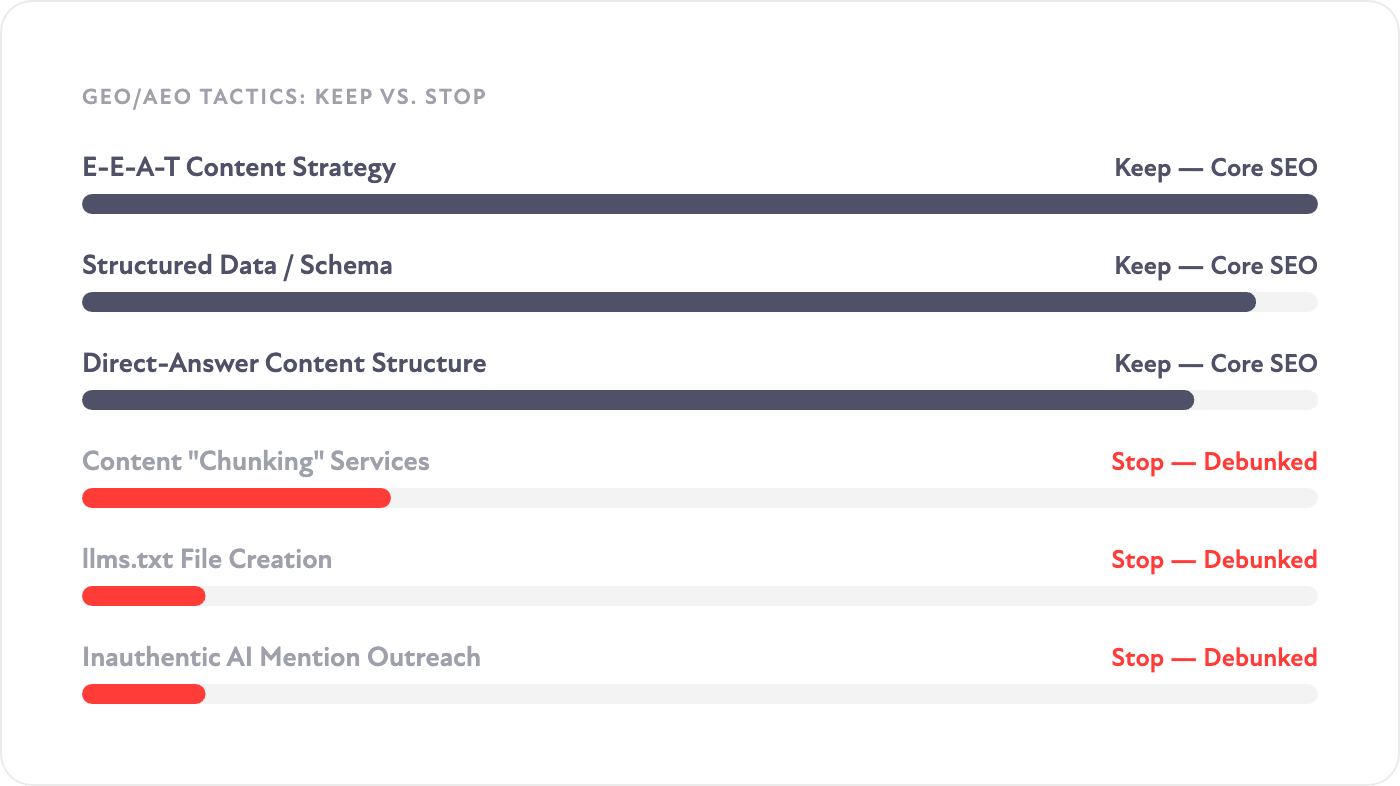
None of this means AI visibility work is a waste of money. It means some specific tactics are. If any of these show up as standalone deliverables in your scope, they’re worth a conversation with your agency:
Chunking strategies. Chunking has a legitimate use in database architecture and AI system design. Applying it to your website content as a “generative search hack” is something else. Google’s position is that well-structured content with direct, clear answers has always been the right approach. Renaming that “chunking” doesn’t make it a new service.
llms.txt file creation. Google says you don’t need it to appear in its AI features. Some other AI platforms and browser agents may read it, but it’s a small technical task, not a strategy, and it shouldn’t be sold as one.
Inauthentic mentions and citation farming. Some vendors sell outreach designed to get AI platforms to “mention” your brand more. Google specifically flagged inauthentic mentions as a tactic to ignore. Real brand signals come from being cited because your content is useful, not because someone emailed a content farm.
AI visibility reporting that lives on an island. Tracking where you show up in AI Overviews, ChatGPT, and Perplexity is worth doing. It works best inside the same reporting you use for organic search, so you can see how the two connect. A separate dashboard that can’t tell you why anything changed is just another login.
The distinction matters for your budget. Our breakdown of SEO, AEO, GEO, and AIO covers what each term meant before Google’s consolidation, which helps if you’ve been trying to map your agency’s scope to real outcomes.
What “It’s All SEO” Means in Practice
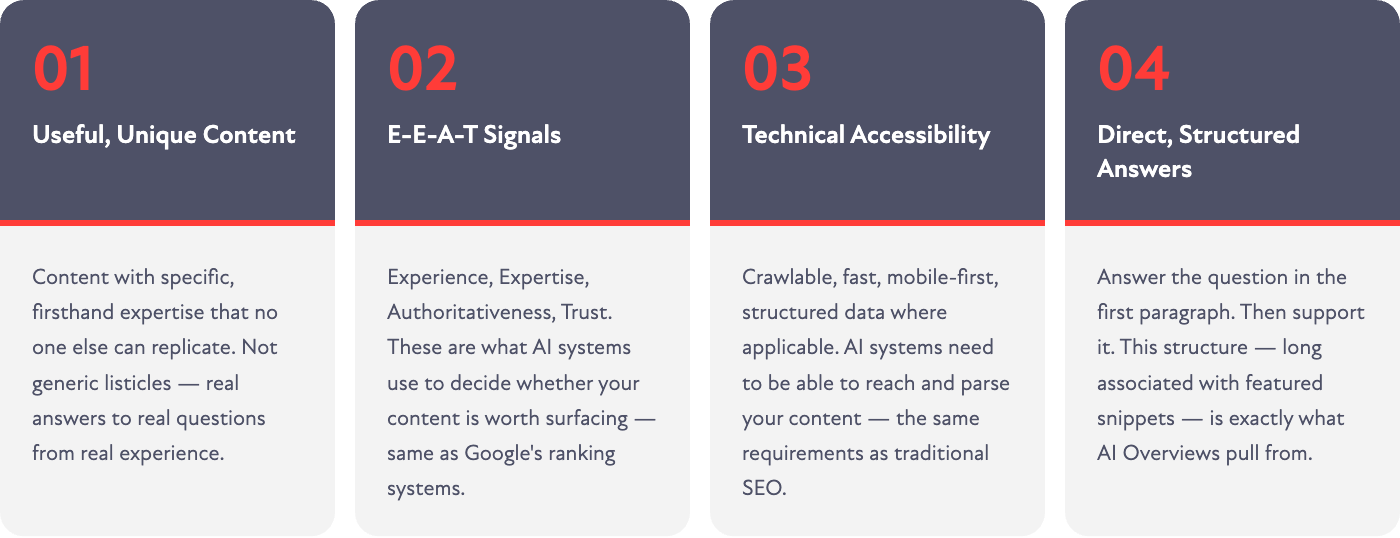
Google isn’t saying nothing has changed. AI Overviews are real. Search behavior is shifting. Users get answers directly in the SERP without clicking through. That’s a real change in how your content gets consumed and cited.
What Google is saying is that the response to those changes isn’t a new discipline. You don’t need a separate strategy for AI search. You need a better SEO strategy, one that accounts for how AI surfaces summarize and cite your content, built on the same foundation: content worth surfacing.
The guide is explicit that creating content people find unique, compelling, and useful will likely influence your presence in generative AI search more than any specific tactic. That sentence should be posted somewhere your content team sees it every day.
In practice, that means less “7 Tips for Homebuyers” and more “Why We Waived the Inspection and What It Cost Us.” Google used that contrast in its documentation to separate commodity content from content AI systems want to surface. Specific. Firsthand. Answering a question no one else answers quite the same way.
The Content Shift That Matters
Google’s guide includes a concrete example of non-commodity content. The commodity version: 7 Tips for First-Time Homebuyers. The non-commodity version: Why We Waived the Inspection and Saved Money: A Look Inside the Sewer Line.
The second one wins. Not because it’s longer, and not because it was “chunked” or tuned for AI. It wins because it contains specific experiences, decisions, real outcomes, and a perspective that couldn’t have come from someone who wasn’t there.
For B2B marketers, this should reshape how you brief your content team. Stop asking for “a blog post about [topic].” Start asking for “our take on [specific situation we encountered] and what it meant for [our clients].” That’s the format AI systems reward, and it’s the same format that’s always built organic authority.
It’s also the harder brief. Generic content is faster, cheaper, and easier to scale. But it increasingly gets lost, in AI search and in regular search. Google’s helpful content updates have pushed this direction for years. The AI Optimization Guide just says it out loud.
If you’re not sure whether your content clears that bar, our guide to why content underperforms is a good starting point. It walks through the signals that show content is too thin to get picked up anywhere.
How to Audit Your Agency’s Work Right Now
You don’t need to blow up your vendor relationship over this. But you should ask the right questions before your next renewal. The question isn’t whether you should invest in AI visibility. It’s whether that investment is connected to your SEO strategy and tied to outcomes you can see.
Start with the scope. Pull your current service agreement and list every deliverable. For any line item labeled GEO, AEO, AI Optimization, or Generative Search, ask what it maps to in actual work product. If the answer is “we create an llms.txt file” or “we chunk your content,” Google’s documentation gives you a place to start that conversation.
Look at your content output. Is your team producing the specific, firsthand content Google’s guide describes? Or a volume of posts that look like every other resource on the internet? Post count isn’t search authority.
Check what’s happening in AI search. Are you being cited in AI Overviews? Where? Which pages? What about ChatGPT and Perplexity? If you’re paying for AI visibility work but can’t see citation data, that’s a gap in accountability. Tracking visibility across SEO, AEO, and GEO inside HubSpot is one way to build reporting that holds the work accountable.
The goal isn’t to slash your marketing budget. It’s to make sure every dollar goes toward work that drives visibility in Google Search, in AI Overviews, and in whatever format search takes next.
What Hasn’t Changed
The fundamentals Google points back to have been the same for years. Being crawlable and indexable. Demonstrating real expertise. Answering questions directly and completely. Building a content library with enough depth to establish authority on a topic.
What’s new is that the AI layer depends on those same signals. AI Overviews draw on well-structured, trustworthy, authoritative content, largely the same content that performs in traditional search. There’s no shortcut around that.
If your SEO foundation is solid, you’re already doing most of the work that positions you for AI search. If it isn’t, no GEO add-on was going to fix that. The conversation that matters now is about the quality of your content, the depth of your topic coverage, and whether your agency is accountable to visibility outcomes rather than line items.
FAQs