Table of Contents
Let me take you back to 2014.
I was sitting in a strategy session with a local services client, and one of the planned blog posts was - and I'm not making this up - "7 Reasons to Hire an Accountant in Pasadena in 2014." That was the title. That was the strategy. And honestly? At the time, it worked. The post ranked well. It pulled traffic. People converted from it.
For two decades, SEO had a known “content is king” north star but there was also a giant game of pattern matching to get an extra edge. You saw companies figure out which keywords had volume, and they would be stuffed into titles, H1s, meta descriptions, and image alt text, and the algorithm actually rewarded them for it (until of course, it didn’t). White text on white backgrounds (in the super early days), keyword density formulas, author markup during the Google Plus era, exact-match domains. The whole thing was a circus.
Thank god that world is gone.
The games are done and the focus is on Entity SEO which is not really new at all. Google has been quietly building toward it since 2012. The arrival of large language models just made the shift impossible to ignore.
What Is Entity SEO?
Entity SEO is the practice of optimizing your content so that search engines and AI systems understand what your brand is, what it does, and what topics it has authority over, not just which keywords appear on your pages.
An "entity" is a thing — a person, a company, a place, a concept, a service category. Google has been organizing the web around entities since it launched the Knowledge Graph in May 2012. That announcement post was literally titled "things, not strings." At launch, the Knowledge Graph already contained more than 500 million objects and 3.5 billion facts about them. Today it's many multiples of that, and it's the scaffolding underneath every modern AI search experience.
Here's the practical version. When you searched "accountant Pasadena" in 2014, Google was matching the literal strings of text on web pages to your query. Today, when someone searches that same phrase or asks ChatGPT "accountant that can help with Eaton Fire victims?" - the system is asking much more sophisticated questions: what entity is this person looking for, in what location, with what context, and which entities have demonstrated authority on this combination?
Notice how different that is. The system isn't looking for a page that says "Pasadena accountant" 47 times. It's looking for the business entity that has accumulated the most contextual signals connecting it to personal and professional accounting services.
Why This Shift Is Happening
Three things converged to push us into the entity-first era. Understanding them matters because they explain why this isn't a trend, it's the new floor.
1. Google got fundamentally smarter about language
In October 2019, Google rolled out BERT to search and called it "the biggest leap forward in the past five years." BERT looks at the full context of a word by analyzing what comes before and after it, rather than reading queries one word at a time. At launch, it affected about 1 in 10 searches in U.S. English. Then came MUM, the Helpful Content updates, and AI Overviews. Each step further from keyword matching and closer to semantic understanding.
Google has publicly stated that roughly 15 percent of all daily searches are queries it has never seen before. If 15 percent of searches are brand new, no amount of keyword research can prepare you for them. The only way to show up is to be the entity that the system recognizes as authoritative on the topic.
2. LLMs entered the chat…literally
ChatGPT launched at the end of 2022. By 2024, AI Overviews were appearing on a huge share of Google's results, and ChatGPT, Perplexity, Claude, and Gemini had become where a growing portion of high-intent research happens. This was especially the case for B2B, where buyers do most of their homework before ever talking to a salesperson.
LLMs don't crawl pages and match keywords. They synthesize. They look across enormous bodies of text, identify which entities are consistently associated with which topics, and assemble answers from that consensus. If your brand isn't part of the topical conversation in a substantive way, you literally do not exist in those answers.
3. The old tactics started actively hurting
Google's Helpful Content updates, rolling out since 2022, were explicitly designed to demote content written for search engines instead of humans. The "7 Reasons to Hire an Accountant in Pasadena in 2014" style of post that used to give an edge quickly became looked at as generic, formulaic, date-stamped, and a massive liability. Sites that built their traffic on that kind of content lost the majority of it and many never got it back.
So we're not just moving toward entity SEO because it's a better idea. We're moving toward it because the alternative is being penalized.
A Tale of Two Accountants
Let’s stick with our Accountant analogy but open it up to a bigger metropolis. Imagine two small accounting firms in Los Angeles, both trying to grow.
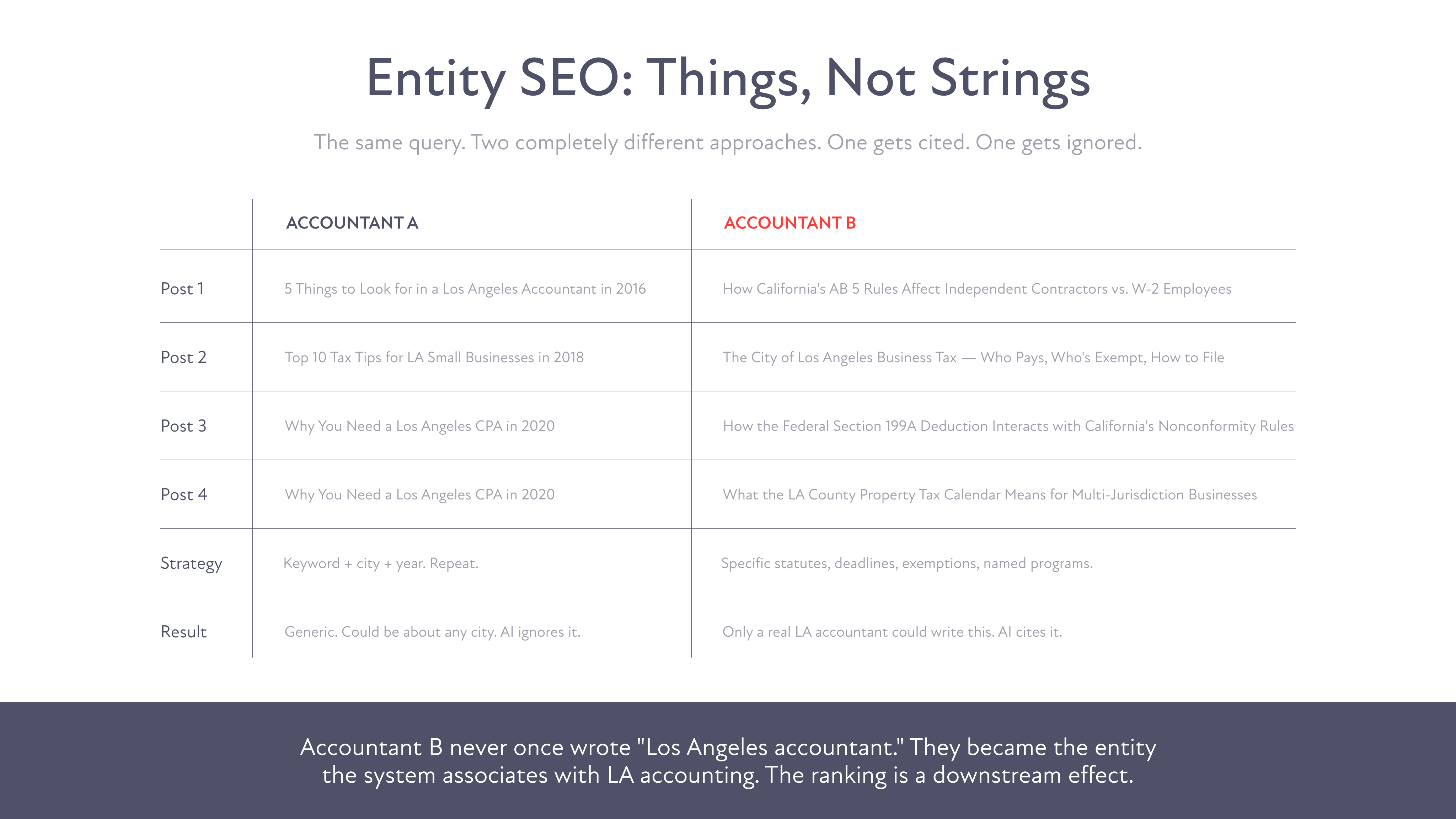
Accountant A is still running that 2014 playbook. Their blog is full of posts like "5 Things to Look for in a Los Angeles Accountant in 2016," "Top 10 Tax Tips for LA Small Businesses in 2018," "Why You Need a Los Angeles CPA in 2020." Every title is built around the same keyword cluster: city + occupation + year. The content underneath is thin, generic, and could honestly be about any city in America with a find-and-replace.
Accountant B does something completely different. They write about:
● How California's AB 5 rules affect independent contractors versus W-2 employees, and what the latest amendments mean for small business owners
● The City of Los Angeles Business Tax - who has to pay it, who qualifies for the small business exemption, and how to file
● How the federal Section 199A pass-through deduction interacts with California's nonconformity rules
● What the LA County property tax calendar means for businesses operating in multiple jurisdictions
Look at those titles. "Los Angeles accountant" doesn't appear in any of them. The keyword "CPA" might not either. And yet, these are posts that only a real LA accountant could write with authority. They're saturated with entity signals: specific municipal ordinances, state statutes, deadlines, exemption thresholds.
Now imagine someone asks ChatGPT: "I run a small business in LA. What local taxes might I be missing?" The model isn't going to pull from Accountant A's "5 Things to Look for" post. It's going to synthesize an answer from sources that demonstrate real knowledge of LA-specific tax structures. Accountant B is exactly that source.
Here's the punchline: Accountant B isn't trying to rank for "Los Angeles accountant." They're becoming the entity that the system associates with Los Angeles accounting. The ranking is a downstream effect. They got there by doing the opposite of what 2016 SEO told them to do - by not forcing the keyword.
What You Need to Do About It
This content shift is freeing in a lot of ways, but it's also harder in others. The old playbook was paint-by-numbers. The new one demands actual editorial judgment. Good for strategists, tough for box-checkers.
Luckily, you box-checkers can have the framework ATAK uses with our clients.
1. Narrowly define your topical lanes
Don't try to win on "marketing" or "accounting" or "manufacturing software." Those are oceans. Pick three to five sub-topics where you can credibly be the most authoritative voice. For an LA accountant, that might be California small business tax compliance, LA County property tax for commercial operators, and entertainment industry pass-through structures. Lanes you can actually own. Every leader we work with initially wants to claim something three times too big (including me!). Narrower wins.
2. Audit your old content before writing anything new
This is one of our core points of view at ATAK: your existing content is almost always more valuable than the new content you haven't written yet. Old posts have accumulated authority signals - backlinks, indexed time, internal links - that a brand new post simply doesn't have. Find the posts that touch your topical lanes but were written in the old keyword-chasing style, and rebuild them to demonstrate entity expertise. You will almost always get more lift from upgrading 30 old posts than from publishing 30 new ones.
3. Stop forcing keywords; start demonstrating expertise
This is the freedom the new era gives you. You don't need to repeat your location and occupation in every H2. Write a piece about a specific California statute and trust that the system will connect the dots between that statute, your firm, and the broader topic of California tax law. Your job is to demonstrate that you actually know things. Cite specific regulations. Use proper terminology. Reference adjacent entities like agencies, statutes, deadlines, named programs. The more of those signals you embed, the more clearly the system understands what you know.
4. Measure what actually matters now
Keyword ranking position used to be the scoreboard. It's still useful, but it's no longer sufficient. You also need to track whether your brand appears in AI Overviews and LLM answers for your target topics, which sources those AI systems are citing, and how your share of voice for a topic (not just a keyword) compares to your competitors.
The Bottom Line
The era of outsmarting the algorithm with tricks is over. Every tactic once thought of as sneaky strategy has become archaic and even harmful. What replaced them isn't another trick. It's a higher bar.
You don't need to be found anymore. You need to be understood.
Understood as the company that knows California tax law inside and out. Understood as the firm that gets manufacturing software implementation. Understood as the agency that helps B2B marketing teams modernize their revenue operations. When the system understands what you are, the ranking takes care of itself.
Stay in your lane. Demonstrate what you know. Let the algorithm catch up to who you already are.
FAQs