Table of Contents
- 1.Why a HubSpot or Development Partner Needs SOC 2
- 2.Why We Chose SOC 2 Type 2
- 3.What the SOC 2 Process Looked Like for a Remote-First Agency
- 4.What SOC 2 Type 2 Means for Our Clients
- 5.If You Run a Vendor Security Review
- 6.What Comes Next: Continuous Monitoring and HIPAA
- 7.SOC 2 Questions We Hear From Clients
- 8.FAQs
Most of our clients hand us the systems their revenue runs on. HubSpot instances with every contact and open deal. Salesforce orgs. Marketing automation wired straight into real customer records. Some of those clients are healthcare organizations, which means protected health information sits inside the platforms we build and manage.
When you pick an agency to run those systems, you are giving a third party deep access to your data. Most buyers ask about design, reporting, and results. Fewer ask the harder question: can this agency actually protect what we hand them, and can they prove it?
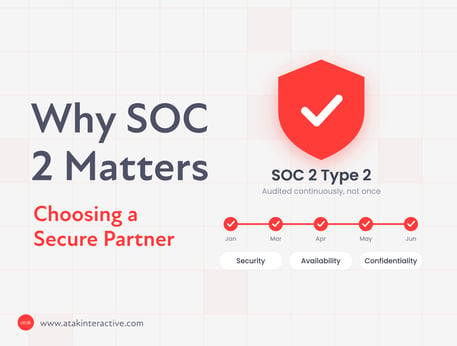
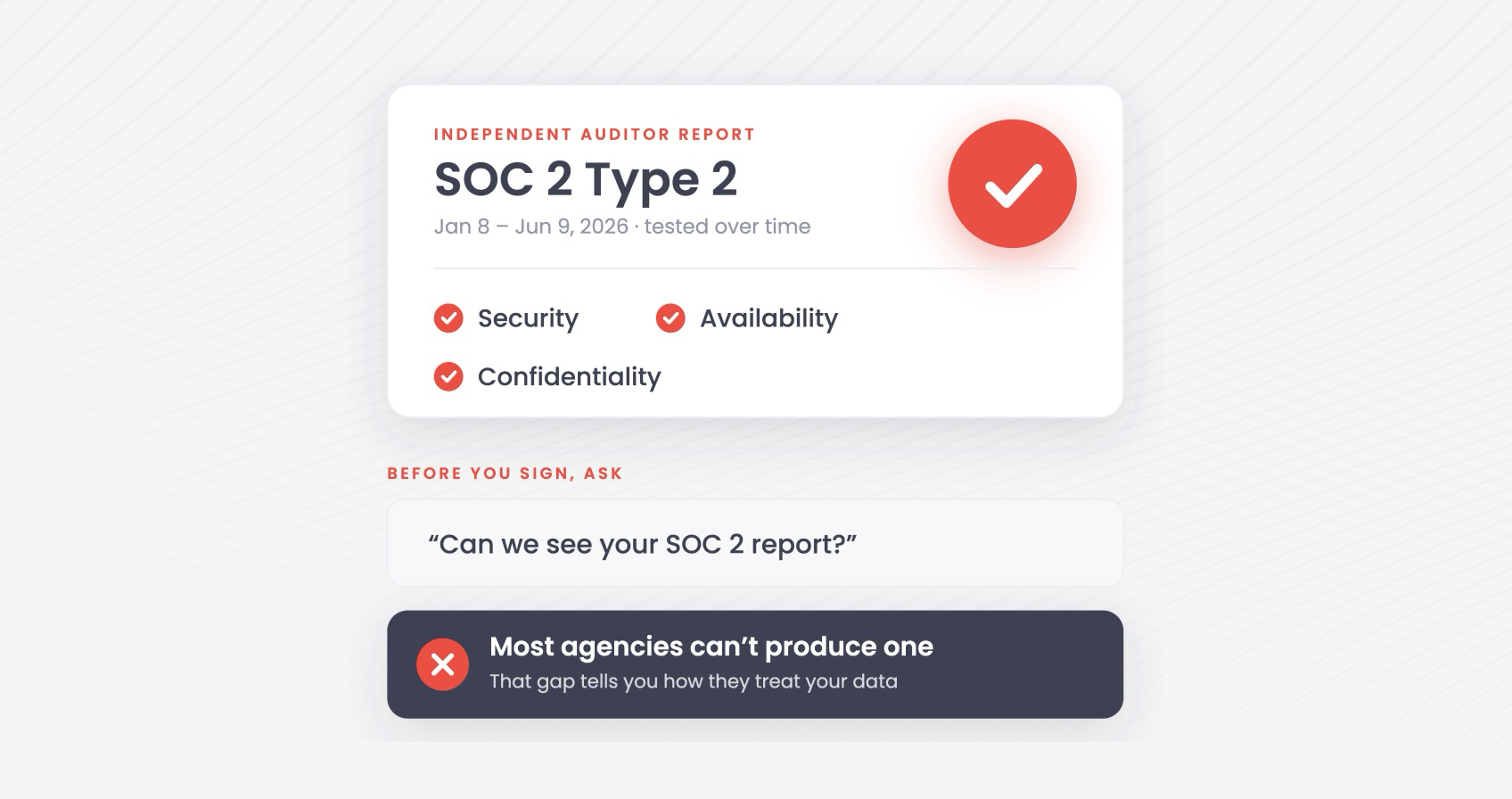
We can now prove it. ATAK completed a SOC 2 Type 2 examination covering Security, Availability, and Confidentiality. Here is what that means, why we did it, and why you should ask about it before you sign with any partner.
Why a HubSpot or Development Partner Needs SOC 2
Agencies sit in a strange spot. We are not the software vendor, but we hold the keys to it. We configure your CRM, connect it to Salesforce, SAP, Shopify, or a custom API, and we often see more of your customer data than your own team does day to day.
That access is the whole point of hiring us. It is also a risk you are taking on. A SOC 2 report is how a serious partner answers that risk with evidence instead of assurances.
Here is a test worth running. Ask any agency pitching you for HubSpot work or custom development to show you their SOC 2 report. How they answer tells you something about how they treat the data they are asking you to trust them with.
Why We Chose SOC 2 Type 2
We didn't pick SOC 2 because it looks good on a homepage. Two things pushed it to the top of the list.
First, our client mix changed. We took on more healthcare work, and PHI started flowing through the CRMs and integrations we manage. You cannot handle that data casually. We were already careful, but "careful" is not something you can hand an auditor.
Second, our enterprise pipeline kept asking. Every $50M+ company we talk to runs a vendor security review before they sign anything. A SOC 2 report answers most of that review before the questions start. We were tired of writing long email replies to security questionnaires when a report does the job better and faster.
We looked at other frameworks. For where we are and who we serve, SOC 2 Type 2 was the right first bar. It covers Security, Availability, and Confidentiality, and a Type 2 report proves the controls held up across a real observation period, not just on the day someone checked. Our report covers the period from January 8, 2026 through June 9, 2026.
What the SOC 2 Process Looked Like for a Remote-First Agency
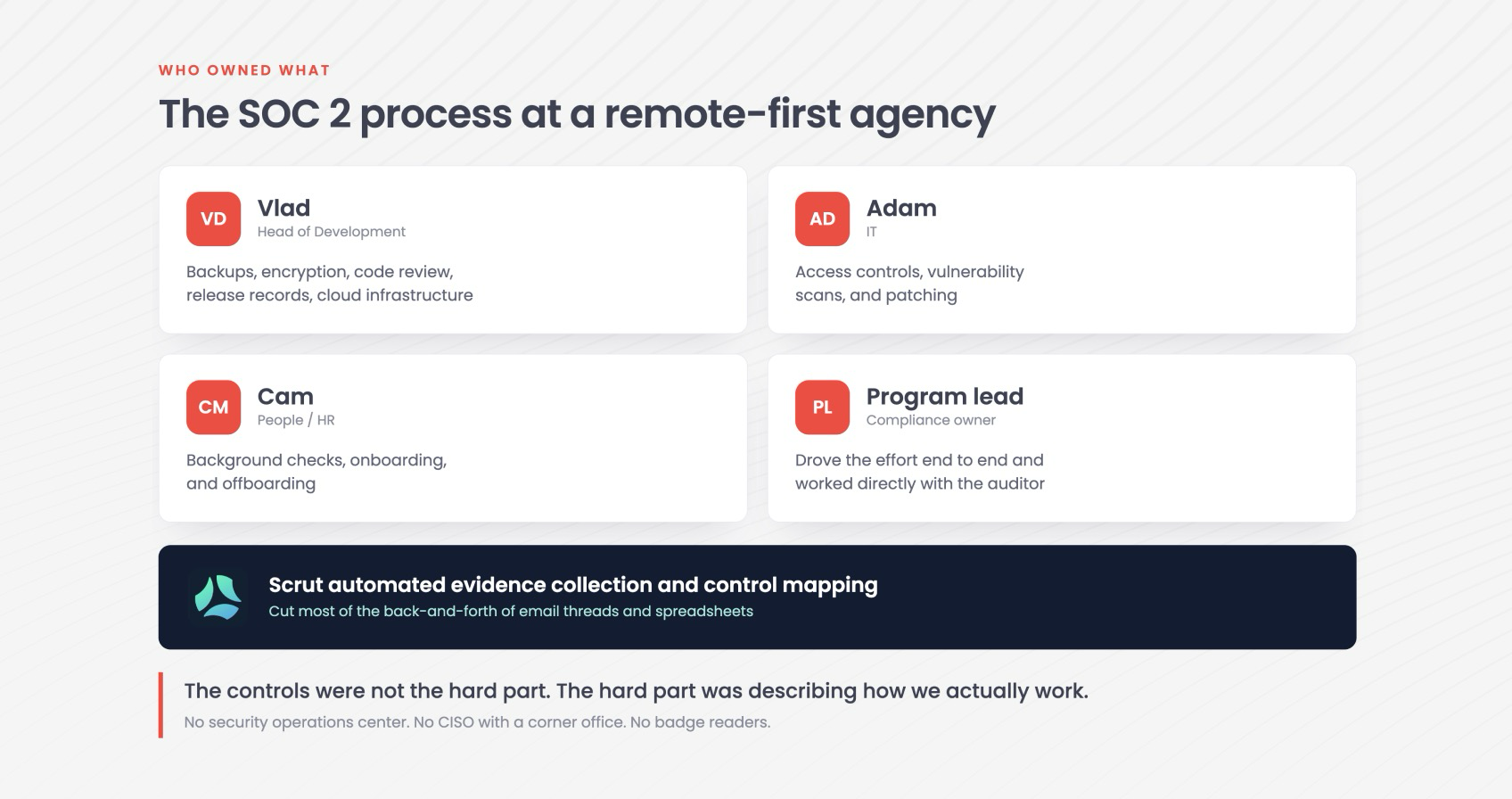
The work split across the people who actually own each area. Vlad, our head of development, handled the technical evidence: backups, encryption, code review, release records, cloud infrastructure. Adam ran access controls, vulnerability scans, and patching on the IT side. Cam covered the HR pieces, background checks, onboarding, and offboarding. I drove the whole effort and worked directly with the auditor.
We used a compliance automation platform to handle evidence collection and control mapping, which cut most of the back-and-forth you'd otherwise burn on email threads and spreadsheets.
Here's the part nobody tells you. The controls were not the hard part. The hard part was describing how we actually work.
We're remote-first. We don't have a security operations center, a CISO with a corner office, or a building with badge readers. A lot of compliance boilerplate assumes you do. Early drafts of our own documentation were full of committees, facilities, and roles that don't exist here. Getting the report to describe the real ATAK, a small senior team running tight systems, took more effort than standing up any single control. If your compliance paperwork describes a company you don't recognize, it's wrong, and a good auditor will find the seams.
What SOC 2 Type 2 Means for Our Clients
If you're a client, or evaluating us as one, a few concrete things are now true and provable:
- We run access reviews on a schedule, not when someone happens to think of it.
- Sensitive actions leave an audit trail.
- Data is encrypted, and we monitor for risk continuously instead of once a year.
- When something goes wrong, there's an incident process, not improvisation.
I'll be straight about who this matters to. If you're a healthcare organization or a larger enterprise with a real security review process, this changes how you evaluate us. If you're a smaller B2B shop that mainly wants better lead flow, it's a signal about how we operate more than a box you needed checked. Either way, it says something about the team. We move fast, and we can still document what we do to an outside auditor's standard. Those two things don't usually live in the same company.
If You Run a Vendor Security Review
This is where the report earns its cost.
When your procurement or security team evaluates ATAK, you'll spend less time chasing answers. We hand you a report and a control set instead of a promise. For a lot of reviews, our SOC 2 report replaces most of the questionnaire outright, which pulls days out of your procurement timeline.
For healthcare clients, we sign Business Associate Agreements, and the controls behind that commitment are now documented and tested, not just written into a contract.
The operational payoff is simple. Faster vendor approval, fewer open security items blocking the work, and a partner your risk team can sign off on without a fight.
What Comes Next: Continuous Monitoring and HIPAA
SOC 2 is not a certificate you frame and forget. The controls have to keep running between audits or the report means nothing a year from now.
- We monitor our controls between audits, so we catch drift instead of discovering it at the next one.
- Security is built into onboarding and offboarding by default, not a step someone has to remember.
- We’ve since completed an independent HIPAA assessment, because it’s what our healthcare clients need alongside SOC 2.
SOC 2 Questions We Hear From Clients
Is ATAK SOC 2 certified? SOC 2 is not a certification. It's an attestation report issued by an independent auditor. ATAK completed a SOC 2 Type 2 examination, which means an auditor tested our controls over time and reported on how they operated. Any partner telling you they are "SOC 2 certified" is using the term loosely.
What Trust Services Criteria does the report cover? Security, Availability, and Confidentiality.
What's the difference between SOC 2 Type 1 and Type 2? Type 1 checks whether your controls are designed correctly at a single point in time. Type 2 checks whether they actually operated over a period, usually several months. Type 2 is the harder bar and the one enterprise buyers expect.
Can we get a copy of ATAK's SOC 2 report? Yes, under NDA. Ask your point of contact and we'll walk you through it.
Does SOC 2 mean ATAK is HIPAA compliant? No. They're separate. SOC 2 covers how we manage security, availability, and confidentiality across our systems. Our HIPAA program was assessed separately in 2026, and we sign BAAs for engagements that touch protected health information.
If you're evaluating ATAK and want to see the report, ask your point of contact. If you're already a client with a question about how any of this affects your systems, reach out to your account lead directly.
FAQs