Table of Contents
Sales says the leads are garbage. Marketing says sales doesn’t follow up. Leadership pulls two different pipeline reports and can’t figure out which one is right. Sound familiar?
Here’s what nobody wants to hear: that tension isn’t a people problem. It’s a system design problem. And the system at the center of it is your CRM.
When lifecycle stages are inconsistent, pipeline definitions mean different things to different teams, and your reporting tools aren’t talking to each other, misalignment is the only logical outcome. You built a revenue team on top of a broken foundation and expected alignment to just happen.
It won’t. Not until the architecture changes.
Misaligned Lifecycle Stages: The Silent Pipeline Killer
Lifecycle stages are supposed to tell everyone the same story. A contact moves from subscriber to lead to MQL to SQL to opportunity to customer. Simple, right?
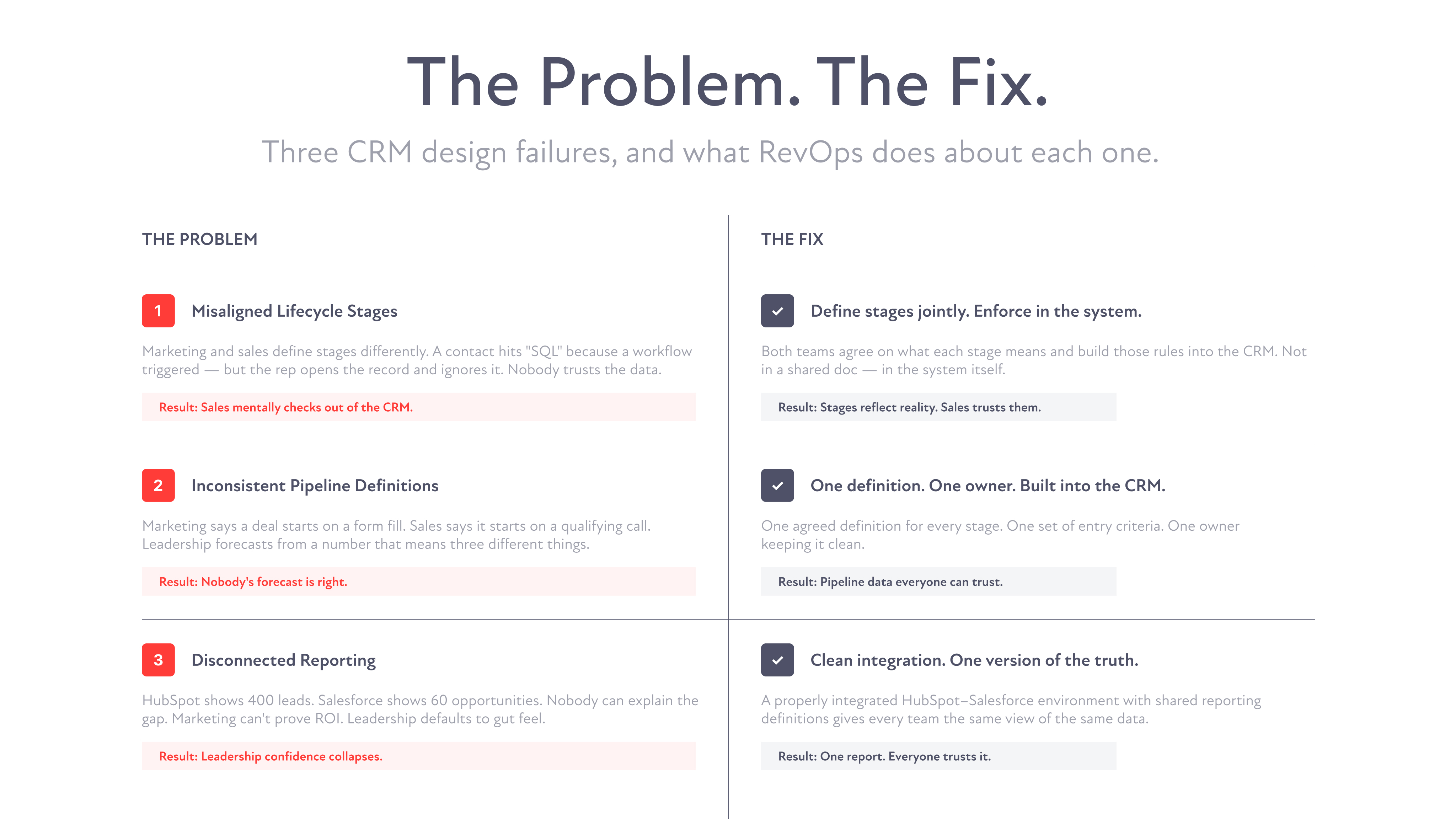
In practice, most companies have marketing defining lifecycle stages one way and sales interpreting them another. A contact hits “SQL” in the CRM because a workflow triggered on a form fill. But the sales rep opens the record, sees someone who downloaded a whitepaper 90 days ago with no budget authority, and immediately ignores it.
The stage said one thing. Reality said another. And now the sales team has mentally checked out of the CRM.
This is what happens when lifecycle stages are built around what the system can automate rather than what the business actually needs. The stages become decorative. Nobody trusts them. And without trust in the data, every conversation between marketing and sales becomes an argument.
Fixing this isn’t a marketing project or a sales project. It’s a RevOps project. Both teams need to sit down, agree on what each stage actually means, define the criteria for every transition, and then build those rules into the CRM. Not in a shared doc. In the system itself.
Read More: The Role of RevOps in Building Scalable Business Processes
Inconsistent Pipeline Definitions: Why Nobody’s Forecast Is Right
Pipeline stages have the same problem. Marketing thinks a deal enters the pipeline when a lead fills out a contact form. Sales thinks a deal enters the pipeline when they’ve had a qualifying call. Leadership is looking at a number that’s somewhere in between and trying to forecast from it.
You can’t build a predictable revenue operation on pipeline data that means three different things depending on who you ask.
The root cause is almost always the same: pipeline stages were set up by whoever owned the CRM at the time, based on what made sense to them, without a cross-functional conversation about what the stages actually need to represent.
What you need is one agreed-upon definition for every stage, one set of criteria that must be met before a deal moves forward, and one owner accountable for keeping it clean. When that structure exists in the CRM, the forecast gets more accurate, coaching conversations get more specific, and marketing can finally tie their efforts to pipeline in a way sales respects.
Read More: AI and Automation in RevOps: What You Need to Know
Disconnected Reporting: When Everyone Has a Different Story
This is the one that kills leadership confidence fastest.
Marketing pulls a report from HubSpot showing 400 leads last quarter. Sales pulls a report from Salesforce showing 60 opportunities. Leadership asks what happened to the other 340 and nobody has a clean answer.
Disconnected reporting between platforms isn’t just an inconvenience. It destroys credibility across the entire revenue function. Marketing stops being able to prove ROI. Sales stops trusting any number that comes from marketing. And leadership starts making decisions based on gut feel because the data can’t be trusted.
The fix requires two things working together. First, a clean integration between your platforms so data is consistent across both. Second, agreed-upon reporting definitions so that when HubSpot says “lead” and Salesforce says “contact,” both records are telling the same story about the same person at the same stage.
When your HubSpot and Salesforce environments are properly integrated and governed, you stop arguing about whose numbers are right. You get one version of the truth, visible to everyone, built on data that actually reflects what’s happening in your pipeline.
This Is a System Design Problem. RevOps Is the Solution.
Every issue above has the same underlying cause: a CRM that was set up without a shared operating model between marketing and sales.
RevOps exists specifically to solve this. Not by adding headcount or restructuring teams, but by building the systems, processes, and governance that make alignment the default outcome rather than something you have to constantly fight for.
That means:
- Lifecycle stages defined jointly and enforced in the CRM
- Pipeline definitions that every stakeholder agrees on before a deal enters
- Reporting infrastructure that gives marketing, sales, and leadership the same view of the same data
- Integrations between platforms that keep records clean and consistent across both
When the architecture is right, the arguments go away. Not because everyone suddenly got along, but because the system stopped manufacturing conflict.
What We See When We Come In
We’ve walked into a lot of CRM environments built on good intentions and bad architecture. Inherited messes from a previous admin. Integrations that sync the wrong fields. Pipeline stages that haven’t been touched since the company was a quarter of its current size.
The teams aren’t the problem. The system is.
Our RevOps work starts with a clear-eyed look at how your lifecycle stages, pipeline definitions, and reporting are actually structured today. Then we rebuild them around how your revenue teams actually operate, with the governance to keep them clean as you grow.
If your sales and marketing teams are stuck in the same argument every quarter, the answer isn’t a better offsite. It’s better architecture.
FAQs