Table of Contents
- 1.Web Development Has Shifted — Here's What Changed
- 2.Trend 1: Server-First Rendering Is the New Default
- 3.Trend 2: AI-Native Development
- 4.Trend 3: Edge Computing Goes Mainstream
- 5.Trend 4: TypeScript Becomes the Baseline
- 6.Trend 5: Headless CMS and Modular Architecture
- 7.Trend 6: Performance as a Business Metric
- 8.Trend 7: Accessibility Is Now Mandatory, Not Optional
- 9.FAQs
7 Most Popular Website Development Trends for 2026
Web Development Has Shifted — Here's What Changed
The original version of this post covered 2023 trends. A lot has happened since. What was experimental then is standard now. What was trending then has either won or quietly died. And a few genuinely new forces have entered the picture.
The biggest shift: the assumption that web development is primarily a front-end problem has collapsed. The pendulum has swung back — the default is now server-first, moving the heavy lifting away from the user's device to make applications feel instant. AI tooling has tripled team productivity at some organizations while also introducing new risks around code quality and architectural drift. And performance is no longer a dev team concern — it's a direct input to SEO, conversion rate, and revenue. Atakinteractive
These seven trends reflect where the industry has actually landed in 2026, not where analysts hoped it would go.
Trend 1: Server-First Rendering Is the New Default
For most of the 2010s, the web moved aggressively toward client-side rendering. Single-page applications loaded a JavaScript bundle and built the page in the browser. It was fast to develop and felt modern. It also produced slower initial load times, worse SEO, and heavier client-side overhead.
With the widespread adoption of React Server Components and Server-Side Rendering, frameworks now render UI on the server by default. You only send the JavaScript that's actually needed for interactivity, keeping the client lightweight. Atakinteractive
Next.js App Router, Nuxt, SvelteKit, and Remix all default to server-first rendering. For businesses, this means faster pages, better Core Web Vitals scores, and content that's immediately readable by search engines — including the AI crawlers that now power AI Overviews and answer engines. The shift isn't about chasing a trend. It's about fixing a structural problem that client-side rendering created at scale.
Trend 2: AI-Native Development
AI has found its way into every stage of how websites get built in 2026 — and the teams not using it are measurably slower than those who are.
68% of developers now use AI to generate code during development. As AI design tools handle more of the grunt work, developers are evolving into overseers and orchestrators — a single experienced developer using the right AI-driven framework can operate with the same efficiency and output as a team of four or five engineers. Atakinteractive
That's the upside. The risk is real too. AI coding tools are accelerators in both directions — they speed up delivery, but they also multiply code volume, inconsistency, and architectural drift if teams don't stay vigilant. Without strong standards, clean patterns, and senior oversight, organizations end up with AI-generated technical debt that costs significantly more to untangle later. ATAK Interactive
For businesses evaluating development partners in 2026, "do you use AI tools" is the wrong question. The right question is: what governance and review processes do you have around AI-generated code? The answer tells you more about quality and maintainability than any framework choice.
AI is also changing the websites themselves, not just how they're built. Websites increasingly use ML models for real-time personalization, conversational interfaces, and predictive recommendations — features that were enterprise-only two years ago and are now accessible at every budget level.
Trend 3: Edge Computing Goes Mainstream
Edge computing — running server logic geographically close to the user rather than from a central data center — has moved from performance optimization to baseline expectation for new builds.
In 2026, edge awareness is a core frontend skill. As more applications default to edge deployments, developers need to design with constraints in mind and treat performance as part of everyday development, not a final optimization step. ATAK Interactive
Platforms like Cloudflare Workers, Vercel Edge Functions, and AWS Lambda@Edge make this accessible without managing infrastructure. For B2B companies with global audiences or performance-sensitive applications, edge deployment means consistent sub-100ms response times regardless of where a visitor is connecting from.
The practical implication: when evaluating frameworks or hosting providers in 2026, edge runtime support is a real criterion, not a marketing checkbox.
Trend 4: TypeScript Becomes the Baseline
This one might seem like a developer-only concern. It isn't.
In 2026, writing plain JavaScript for a professional project is considered a legacy approach. TypeScript has become the baseline, fueled by end-to-end type safety. Every major framework defaults to it. AI coding tools perform measurably better with TypeScript's type information. Teams using it catch more bugs before code ships, write more self-documenting code, and refactor more safely as projects grow. ATAK Interactive
For anyone making decisions about web projects — not just writing the code — TypeScript matters because it directly affects long-term maintenance costs. A codebase built with TypeScript is easier to hand off, easier to scale, and cheaper to maintain over time than an equivalent JavaScript codebase. It's become one of the clearest signals that a development team is building for durability, not just delivery speed.
Trend 5: Headless CMS and Modular Architecture
The way websites manage and deliver content has fundamentally changed. Headless CMS trends are accelerating as businesses demand flexibility, scalability, and faster development cycles — separating content management from presentation and allowing developers to deliver content across multiple platforms through APIs. Atakinteractive
In practice this means content editors work in a familiar interface (Sanity, Contentful, Payload, or HubSpot Content Hub) while developers have full control over how that content is rendered, where it's delivered, and how it performs. The same content can power a website, a mobile app, and an AI-readable API endpoint without duplication.
Modular architecture breaks the website into independent components, letting teams update features, content, or layouts independently and launch new channels without rebuilding the entire website. Refontelearning
For businesses planning a new build or replatform in 2026, the question to ask a development partner isn't "what CMS do you use" — it's "how is content decoupled from presentation, and how does that affect our ability to update and extend the site without a full rebuild." The answer determines your total cost of ownership more than almost any other architectural decision. Our guide to HubSpot Content Hub covers what that looks like in practice for B2B companies already running HubSpot.
Trend 6: Performance as a Business Metric
Performance used to live in the engineering team's OKRs. In 2026 it belongs in the marketing and revenue conversation too.
Website performance optimization remains a dominant focus heading into 2026. Search engines prioritize fast-loading, stable, and responsive websites, making performance-first development a critical ranking and usability factor. Performance-focused development directly impacts Core Web Vitals, which influence both SEO rankings and user satisfaction. Atakinteractive
That's the SEO angle. But the conversion angle is just as direct: a one-second improvement in page load time has been shown to improve conversion rates by 7% on average. For a B2B company running paid campaigns, that's not a developer metric — it's a revenue metric.
In 2026, performance-first development means building websites that load fast and feel smooth, especially on mobile — with the real value being instant loading, smoother interactions, and reliable performance even when the network is weak. Refontelearning
Practically, this means choosing frameworks with server-side rendering and edge support (see Trends 1 and 3), optimizing images and assets aggressively, and treating Core Web Vitals as a standing KPI — not a one-time audit. If you want to understand how technical performance connects to your search visibility specifically, our breakdown of why your website traffic is dropping even though you're still ranking is a good starting point.
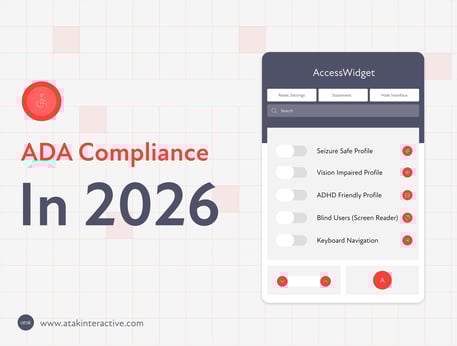
Trend 7: Accessibility Is Now Mandatory, Not Optional
Accessibility has been on the "we should do this" list at most companies for years. In 2026 it's moved to the "we have to do this" column — and the deadline is real.
The European Accessibility Act comes into enforcement in June 2026, requiring digital accessibility compliance for businesses operating in or selling to EU markets. In the US, ADA-related website litigation has continued to increase, and WCAG 2.2 AA is now the recognized standard referenced in most cases — replacing the older 2.1 guidelines that many sites were built to.
Compliance for WCAG and "Consent UX" — the design of user interfaces and flows that ethically obtain user permission for data collection and use — is becoming mandatory, not just a best practice. ATAK Interactive
Beyond compliance, there's a business case. Accessible sites load faster, have cleaner semantic HTML (which AI crawlers favor), and convert better across users with diverse needs. The overlap between accessibility best practices and SEO best practices has never been more complete.
For B2B companies specifically, accessibility failures create real liability exposure. If your site hasn't been audited against WCAG 2.2 AA, that's the first thing to fix in 2026 — before the design refresh, before the new landing pages, before the paid campaign.
FAQs
What are the biggest web development trends in 2026?
The seven trends with the most real-world impact in 2026 are: server-first rendering, AI-native development, edge computing, TypeScript as the default language, headless CMS and modular architecture, performance as a direct business metric, and mandatory accessibility compliance. These aren't emerging trends — they're already the standard at companies building serious web products.
What is server-first rendering and why does it matter?
Server-first rendering means the web server builds the page HTML before sending it to the browser, rather than having the browser build it from a JavaScript bundle. The result is faster initial load times, better SEO because content is immediately readable, and lighter client-side performance. React Server Components and meta-frameworks like Next.js and Nuxt have made this the default for most new professional projects in 2026.
Is AI actually changing web development or is it hype?
It's genuinely changing it — but not evenly. Teams using AI coding tools like Cursor and GitHub Copilot are shipping faster. The risk is that AI also generates more code, more quickly, which creates maintenance problems if there's no strong review process in place. The best development teams in 2026 use AI as an accelerator within disciplined architectural standards, not as a replacement for senior engineering judgment.
What is a headless CMS and does my business need one?
A headless CMS separates where you manage content from how it's displayed. Instead of a traditional CMS where the content management and front-end are bundled together, a headless setup lets developers choose any front-end while editors work in a familiar interface. You probably need one if you're managing content across multiple channels, if your current site is hard to update without developer involvement, or if you're planning to scale content volume significantly. For B2B companies already using HubSpot, Content Hub provides a headless-adjacent setup without adding another vendor to the stack.